Pages

Showing posts with label Lp(a). Show all posts

Thursday, February 6, 2025

The Lp(a)-Lowering Drug Race

Cardiovascular disease (CVD) remains a leading cause of death and morbidity worldwide.  According to the WHO, 18 million of the 68 million deaths annually can be attributed to it.  That's more than 1 in 4. This does not include those whose quality of life is severely impacted by it.  Despite the positive impact of LDLc-lowering drugs (statins, PCSK9 inhibitors), blood-lowering, anti-diabetic, and weight-loss medications, other risk factors remain to be addressed.

Among them is lipoprotein little a [Lp(a)], an independent and causal risk factor for cardiovascular disease.  Except for a few with extremely high Lp(a) who were lucky enough to be diagnosed, often after family members encountered cardiovascular events early in life, it has been largely met with a shrug in general medicine.  The dynamic, however, is quickly changing now as the PCSK9 outcomes trials are strongly supportive that lowering Lp(a) should be able to lower CVD risk (O'Donoghue et al 2019) and new strategies mostly centered around sequence-targeted therapeutics allow for robust Lp(a) reductions.

This week, Novartis disclosed that the eagerly anticipated results from the pivotal trial of the most advanced of these clinical candidates, the RNaseH antisense compound pelacarsen has been delayed.  It was originally projected to deliver results in 2025, but is now guided to read out in the first half of 2026.  As this has raised a few eyebrows, I will take the opportunity to provide an overview of the Lp(a) competitive landscape and the pharmaceutical companies involved.


Lp(a) is a genetic determinant of CVD risk independent of LDLc and ApoB100


Lp(a) is quite similar to LDL-cholesterol lipoprotein particle, but in addition to carrying one molecule of apolipoprotein B 100, cholesterol and phospholipids in its outer shell, there is a apolipoprotein (a) molecule attached to ApoB100 via a disulfide bond.  If LDL cholesterol is referred to as the ‘bad’ cholesterol, Lp(a) on a per particle basis is the lipoprotein supervillain.  It not only gets more easily through the blood vessel endothelial cell layer so that it becomes a substrate for plaque build up, it is quite inflammatory as a result of being a good carrier of oxidized phospholipids.  It is also thought that there may be a prothrombotic effect partly due to its similarity and evolutionary relationship with plasminogen.   
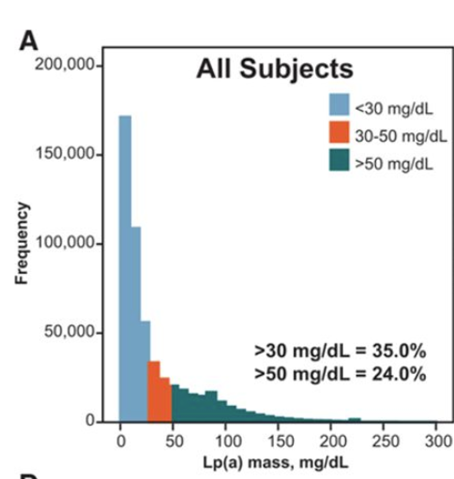
Lp(a) distribution in general population (from Varvel et al 2016)

Unlike LDLc, Lp(a) levels are largely genetically determined and cannot be modified by nutrition and exercise.  They stay more or less constant after 5 years of age.  Levels range widely within a population.  Whereas many have Lp(a) levels of 10mg/dL or less (~22nM), the distribution has a long tail with ~10% of the population, especially black people, who have more than 90mg/dL.  This puts them at ~1.4x and higher risk of suffering CVD events like CVD death, myocardial infarction or of developing calcific aortic valve and peripheral artery disease (Erqou et al 2009).  The increased risk is maintained after having suffered a first event with almost 2x the risk for persons in the top decile versus those below 10mg/dL (Madsen et al 2020).  This is relevant when thinking about using Lp(a) lowering as a strategy for primary or secondary CVD prevention.


Evidence that intervention can reduce CVD risk

Currently the best advice one can give to somebody with highly elevated familial Lp(a) is to address all the other modifiable CVD risk factors.  In terms of medication, this typically means LDLc-lowering by statins and, even better so, the newer PCSK9 inhibitors.

This is because PCSK9 inhibition reduces Lp(a) by 20-30% (Sabatine et al 2017; Schwartz et al 2018; Ray et al 2017) .  The high variability of the Lp(a) reduction between subjects allowed for the determination that in the FOURIER trial of Amgen’s evolocumab there was a 15% relative risk reduction for certain cardiovascular events for each 25nM Lp(a) lowering (~11.6mg/dL; O'Donoghue et al 2019).  Remarkably, those above the median Lp(a) at baseline (37nM) not only had the highest absolute Lp(a) reduction, they had a 23% lower CVD hazard ratio versus only 9% for those below the median.  Importantly, these findings were independent of the magnitude of LDL-c lowering in the same subjects  which was the same across the Lp(a) ranges.

This in my mind is the strongest evidence that not only life-long differences in Lp(a) have a meaningful impact on CVD risk, but even just 5 years of pharmaceutically lowering Lp(a) may have a big impact.


The Lp(a) competitive landscape

It is therefore not surprising that half a dozen or so notable Lp(a)-lowering efforts are in clinical development.  At the same time, medical societies like the EAS, EHA and AHa and KOLs are busy raising awareness around Lp(a).  Still, a lot of work remains to be done: less than 1% in the western medical systems have been tested, despite the fact that guidelines are increasingly recommending getting tested at least once in a lifetime. While universal numbers are hard to come by, reports from various health systems suggest that testing is finally gaining traction (e.g. Bhatia et al 2023).  The pump is thus getting primed for the successful roll-out of Lp(a)-lowering agents.


RNaseH pelacarsen (Ionis, Novartis)

Leading the pack is pelacarsen, originally discovered and developed by Ionis Pharmaceuticals and subsequently licensed to Novartis in 2019.  Pelacarsen is a subcutaneously administered GalNAc-ASO working by RNaseH-mediated knockdown of apo(a) mRNA.   It is currently in a global pivotal phase 3, Lp(a)HORIZON outcomes study evaluating its ability to reduce major cardiovascular events (MACE) in a secondary prevention setting in 8000+ patients with Lp(a) >70mg/dL.

The 80mg once monthly should achieve 80% Lp(a) lowering based on a phase IIb study in a similar population (Tsimikas et al 2020).  Safety and tolerability have been good.  This means an absolute reduction of ~55-60mg/dL for a patient at the lower end of the range, a number that has been estimated (Madsen et al 2020) to be enough for ~20% relative risk reduction.  

Given the uncertainties about the exact relationship between pharmaceutical Lp(a) lowering and risk reduction, Novartis conservatively added a second cut analyzing the effect of pelacarsen in the population with >90mg/dL of baseline Lp(a) for efficacy.  If the study hits in either cohort, it can be considered successful.

The study is an event-driven one, meaning that in this case 993 MACE need to accumulate.  The fact that the data monitoring committee (DMC) has apparently communicated to Novartis that the projected results are now due in 2026 instead of 2025 suggests that insufficient MACE events have occurred since study start in 2019 and completion of enrolment in mid-2022 (2 ½ years minimal follow-up).  

It is plausible that the slower-than-anticipated event rate has to do with a population that is highly controlled for other risk factors, especially LDLc, as I expect most to be on maximally tolerated statins and a good proportion on PCSK9 therapeutics, too.  More optimistically, slow event accrual could also be due to an extraordinary efficacy of pelacarsen.  I suspect, however, that the trial protocol provided for interim looks not only for futility (early looks), but also for efficacy at this late stage of the trial.  The most likely scenario therefore is that the DMC saw maybe 800 events and concluded that the study would benefit from running its full course.  At the very least, the study was not stopped for futility.  

Personally, 70mg/dL is too low a baseline Lp(a) to expect a strong MACE response.  I see Lp(a)-lowering to have most initial utility in the top Lp(a) decile (>90-100mg/dL) and it would therfore not surprise me if HORIZON only hit in that bracket.


RNAi olpasiran (Arrowhead, Amgen)

Hot on the heels of pelacarsen is olpasiran, an RNAi agent discovered by Arrowhead Pharmaceuticals, licensed to and now in development by Amgen.  This liver-targeted RNAi trigger commenced a pivotal phase 3 trial in another secondary prevention study for atherosclerotic cardiovascular disease in 2022 and has finished enrolling 7000+ subjects in just 1 ½ years.  This means that results from OCEAN(a) Outcomes could become available within a year of Lp(a)HORIZON in late 2026. 

The apparent enthusiasm by Amgen is encouraging since they, as the developer of PCSK9 antibody Repatha, are best positioned to understand the likely impact of modulating Lp(a) on CVD outcomes.  In addition, the efficacy of olpasiran trounces that of pelacarsen with a time-averaged Lp(a) reduction of more than 95% (vs -80%) despite of using quarterly instead of monthly subcutaneous dosing (O'Donoghue et al 2022).  The marked difference in efficacy will also allow for insights into whether, as is widely assumed now and as is the case for LDLc, it is the absolute Lp(a) lowering that matters or the relative percent lowering. 

Finally, I like the study because it focuses on a population in the top decile of baseline Lp(a) (>200nMol, ca >90mg/dL) where genetically CVD risk increases exponentially.  I also would not be surprised if lowering Lp(a) well below the genetically defined 50mg/dL risk threshold brings further benefit in an interventional setting.  Doing everything to keep these streaky macrophages from bursting by depriving them of their oxidized fatty meals could be quite beneficial.


RNAi lepodisiran (Dicerna, Eli Lilly)

Two years behind olpasiran in terms of phase 3 initiation, but every bit as potent and even more long-lived in its Lp(a)-lowering activity is RNAi rival lepodisiran.  Lepodisiran is a Dicer-substrate RNAi molecule discovered by Dicerna (now Novo Nordisk) and developed by Eli Lilly.

Lp(a)-lowering by single dose of lepodisiran


In a single dose study, a large dose of 608mg, achieved time-averaged ~95% reduction in Lp(a) over a year.  A lower dose of 304mg effectively lowered Lp(a) by a peak ~98% in the first months before leveling off at around 90% at the half year mark (Nissen et al 2023).  

The ACCLAIM-Lp(a) ASCVD phase 3 study in 12500 subjects in secondary prevention and for those at high risk will test 3 semi-annual doses before moving on to annual dosing.  Though the dose has not been disclosed, I consider both 608mg and 304mg dosages possible with this dosing regime.  The choice will have probably been strongly informed by whether Eli Lilly believes the clinical benefit of going from 10nM to 5nM Lp(a) will balance out formulation, drug administration, and potentially safety issues coming with the high dose.

Besides Eli Lilly, Novo Nordisk, Amgen, and pretty much everybody with a stake in the lipid-related CVD market believe in the advantages of infrequent drug administration as evidenced by their investments in this area.  Novartis this quarter saw the PCSK9-targeting RNAi drug Leqvio (licensed from Alnylam) cross the $1B run-rate for the first time.  It is 284mg of canonical siRNA oligonucleotide administered basically semi-annually.  This demonstrates the shift from daily oral pills that most people will have stopped using after a year despite their need for life-long treatment.  This is understandable since most of them do not suffer acute symptoms. 
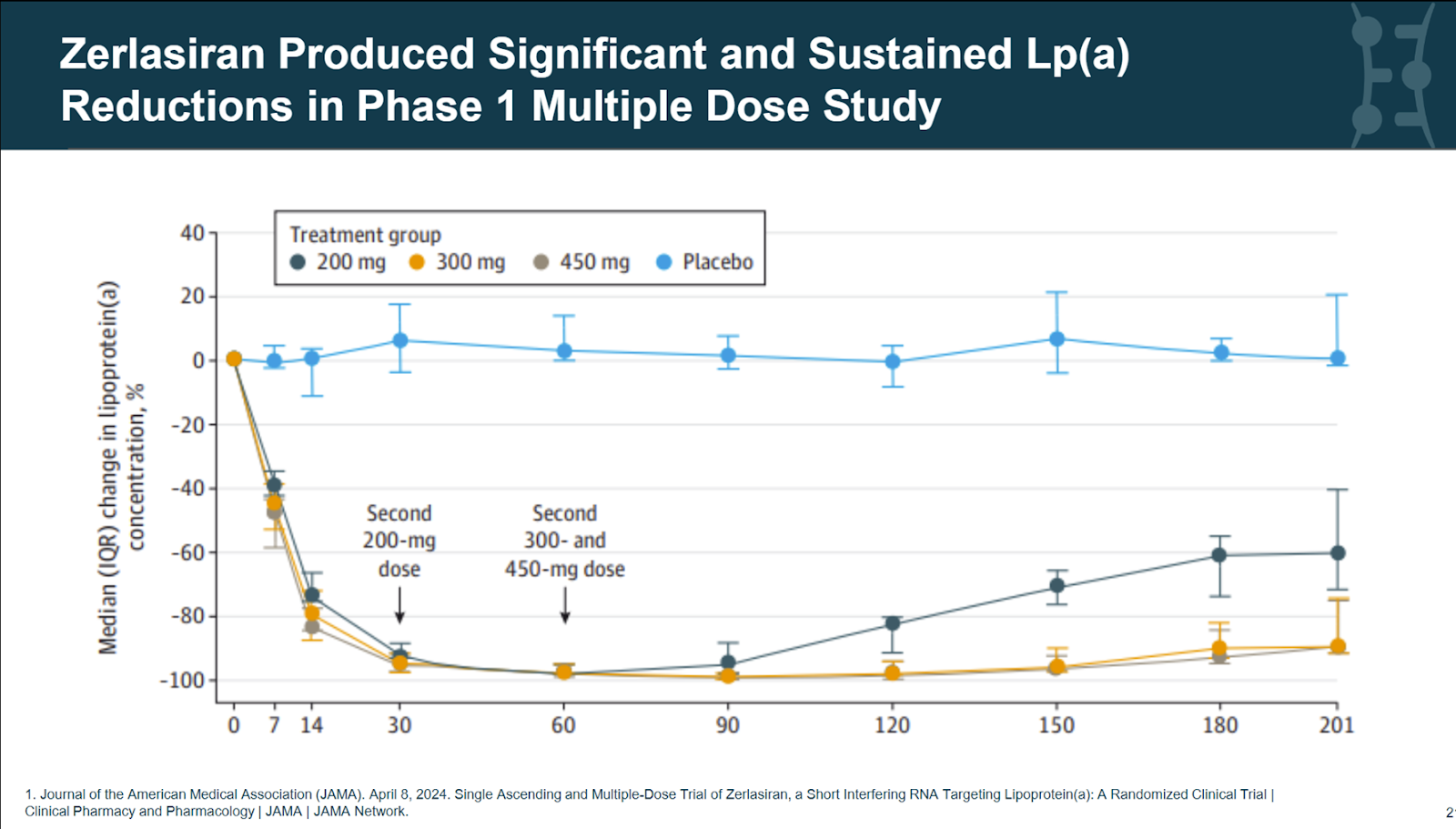
2-dose study of zerlasiran

This brings us to the final notable RNAi contender, zerlasiran by Silence Therapeutics.  In early trials, 300mg showed clear potential for maintaining Lp(a) reduction of more than 95% using quarterly dosing.  Being phase 3 ready, Silence Therapeutics stood to benefit the most from a timely Lp(a)HORIZON reveal by Novartis.  Not only may have they been able to adjust their Lp(a) target levels for their outcomes trial, a successful readout may also have been the trigger for a Big Pharma like Pfizer or Merck with no stake in Lp(a) yet to acquire zerlasiran, if not acquire Silence Therapeutics (market cap $300M) altogether.  

Life-long Lp(a)-lowering using CRISPR genome editing

If you like infrequent dosing, why stop at semi-annual or annual when there are life-long options going after the same apolipoprotein(a) target?  This includes base editor VERVE-301 by cardiovascular specialty company Verve Therapeutics which is partnered with Eli Lilly, but still in preclinical development.  Already in phase I is competitor CTX-320 by CRISPR Therapeutics using more traditional CRISPR Cas9 cleavage of apo(a).  Both use standard intravenous LNP delivery to liver hepatocytes.

Finally, in addition to RNAi and CRISPR, Eli Lilly is also developing an oral small molecule drug. Muvalaplin is designed to inhibit the interaction between ApoB100 and Apo(a) and thus the biogenesis of the Lp(a) particle.  Daily doses barely lower Lp(a) by 60% and as a small molecule there are concerns about hemodynamic effects given the similarities of apo(a) and plasminogen (Nicholls et al 2023).


Disclosure: I have been and am still positioning myself for HORIZON by investing across the Lp(a) landscape, including Silence Therapeutics, Verve Therapeutics and Ionis.  Focused Lp(a) testing companies would also fall into my interest area, so please pitch me ideas if you have some in this area.


Monday, May 14, 2018

Busy Week in Oligonucleotide Therapeutics

Ionis-Akcea ApoCIII Panel

Alnylam CNS Aspirations

Arrowhead Cardiovascular Data 

Dicerna Deal Pre-Announcement


It’s been a very busy week in the Oligonucleotide Therapeutics space, so I thought to memorialize the most important events of last week with this blog entry. 

Difficult Volanesorsen Panel

The highlight of the week certainly was the Advisory Committee on Volanesorsen (VLN; commercial name WAYLIVRA) for the treatment of Familial Chylomicronemia Syndrome (FCS) hypertriglyceridemia.  Here, the FDA, experts in the field, and sponsor Akcea Therapeutics were struggling to assess the risk:benefit of the ApoCIII-targeting phosphorothioate antisense gapmer. I had previewed the panel here.  

As I had expected, the majority voted yes on whether VLN should be approved for FCS.  

While following a very strict diet can be a powerful risk mitigator in FCS, it greatly affects quality of life and alone cannot absolve patients from the risk of pancreatitis attacks, abdominal pain and a range of other morbidities related to having very high triglyceride levels in the blood.  Because VLN is by far the most effective agent for lowering triglyceride, I would have been very surprised in this era of patient choice if a panel of experts wanted it to be out of reach for them.

Unfortunately, aside from on-target pharmacological efficacy, VLN performed very poor in terms of safety and tolerability.  Moreover, the trial was too small and ill-designed to tease out real disease benefits such as a lower pancreatitis attack rate and improved quality of life.  Not even a trend in favor of VLN could be discerned here.

As a result, the discussion was mostly centered around what an effective risk mitigation program (REMS) could look like to prevent dangerous bleeding events caused by the thrombocyte-(= platelet-) suppressing activity of VLN, the adverse event that was singled out as most concerning. 

Unfortunately, the practical experience with VLN showed that even closely following platelet counts and stopping VLN administration or adjusting dosing frequency in response to dropping levels are not able to stop such bleeding risk from continuing.  As such, it is to be expected that VLN will get onto the market without a really satisfactory REMS and that patients may have to accept the bleeding risk, knowing that treating physicians will be ready to administer steroids and/or IVIG should platelets drop to extremely low levels.

Due to thrombocytopenia and the range of other safety and tolerability issues and safety monitoring demands, there is a real possibility that VLN will mostly be a placeholder until safer ApoCIII-lowering alternatives can get approved.  In light of what we have learned from mipomersen and TTR-lowering drug Inotersen, the most negative impact of the VLN data is probably on the potential of systemically administered phosphorothioate antisense oligos outside of the liver.  While GalNAc for the liver and potentially GLP-1 peptides for pancreatic beta cells should keep required ASO levels substantially below the 200-300mg/week dose known to cause the tox and tolerability issues, the prospect for tissues, including muscle, that require systemic ASO administrations is less bright.

Having said that, there could be very simple solutions such as minimal reductions in the extent of phosphorothioation that miraculously can get rid of most of these side effects.  In the absence of a reliable animal model system, however, learning the rules in the clinic could take quite a few more years.  

Alnylam announces CNS aspirations

Another highlight of the week in Oligonucleotide Therapeutics was Alnylam’scoming out in applying RNAi for gene knockdown in the central nervous system (see presentation here). 

While CNS had been an area of interest of the company in its early days (Huntington’s Disease collaboration with Medtronic, a Parkinson’s program), the direct intrastriatal injection results and delivery approaches with old RNAi trigger formats were far from promising for clinical translation.  Not surprisingly, CNS had dropped off the corporate radar.

With the lesson learned from GalNAc-RNAi for the liver, most notably that of the importance of high chemical stabilization and ligands to maximize both oligonucleotide concentration and cellular uptake, and the surprisingly broad CNS biodistribution seen following intrathecal administration of antisense oligonucleotides by Ionis, it was only a matter of time that companies in the RNAi space would re-visit ‘old tissues’ for RNAi.  So with Arrowhead stoking interest in its RNAi efforts in the lung and Alnylam now in the CNS, RNAi is on the cusp of shedding its perception that it is ‘only for the liver’.  And unlike Ionis and Akcea, the RNAi space has street cred so that the capital markets are likely to buy into those claims.

To make matters worse for Ionis, Alnylam is now predicting that (similar to the liver), knockdown with its RNAi molecules should be longer-lived and much better tolerated than the phosphorotioate competition (from Ionis and Biogen): 

'Expect superior potency, duration and systemic safety profile vs. ASOs'

In light of the limited though promising public data (single rat intrathecal injection of 0.9mg of RNAi trigger causing substantial, ~75% target gene lowering for at least 1 month, the latest time point measured), it is too early to decide whether that’s true.  More information on this subject should, however, emerge over the next 2 years by which time Alnylam plans to file its first IND for the CNS.

Arrowhead highlights cardiovascular pipeline

Arrowhead Pharmaceuticals seems to have repaired relationships with investors following its DPC Waterloo and is increasingly getting credit for its GalNAc-based turnaround.  Outside of its lead programs in HBV and AAT-related liver disease, it is cardiovascular disease indications that are the focus of these efforts.

So at ATVB, the company presented an update on these programs with a focus on ANGPTL3 for the treatment of a range of lipid-related abnormalities, especially hypertriglyceridemia.  Of note, first monkey data showed that the administration of therapeutically relevant 3mg/kg triggered robust, 80% target gene knockdown lasting for more than 4 weeks. 

With INDs/CTAs planned for both ANGPTL3 and ApoCIII as well as potentially Lp(a) by partner Amgen anticipated before the end of the year, 2019 promises to be a clinical data-rich year for RNAi in cardiovascular disease.

Dicerna kind of pre-announces AAT-deal as investors get ready to sell shares

Much of what is going on behind the scenes at Dicerna is currently only being reflected by its SEC filings.  

On May 4, large shareholders who had supported the company throughout its litigation with Alnylam and now stand to be richly rewarded for it (~5x gain currently) had their shares registered for sale in an S-3 filing.  These shares account for a whopping roughly half of the shares outstanding.

To bring all investors up to speed, such a registration necessitates the filing of a prospectus.  Interestingly, this document was very specific in that the company now expects to partner the mystery orphan-disease candidate it has been talking about for quite some time this quarter:

‘We plan to seek a risk-sharing collaborator for this program before we file an IND and/or CTA, which we expect to be prepared to file in the second quarter of 2018.’

The document also removes any doubt that the secret target of that program is alpha-1-antitrypsin:

‘The protein causes progressive liver damage and fibrosis, in some cases leading to cirrhosis and liver failure, and we believe that silencing of the disease gene will prevent production of the abnormal protein and thereby slow or stop progression of the liver fibrosis. Greater than 100,000 people in the United States (“U.S.”) are believed to be homozygous (i.e. having identical pairs of genes for any given pair of hereditary characteristics) for the mutation that causes the liver disease, and at least 20% of those people, and potentially a significantly higher fraction, are believed to have liver-associated disease as a consequence.’

So if you were mesmerized by the stocks recent strong performance on modest volume, here’s a conspiracy theory: the company is helping supportive investors to get out on a high volume day that an AAT deal announcement would precipitate.  And spending a few bucks to run the shares up is well worth the investment. 

If the events unfolds as I speculate, it is yet another powerful reminder it is not sufficient for investors to merely follow the press releases, but carefully read the regulatory filings, even if they may seem dry and overly long. 

Addendum 15May18: on its quarterly conference call, Dicerna clarified its convoluted statement in the prospectus regarding the timing of partnership and IND of the mystery candidate. Accordingly, the candidate will be ready for IND/CTA filing by the end of Q2. An actual filing, however, will have to await a partnership which the company now guides for the second half of this year.  Apparently, they are currently in talks with 'more than two' potential partners.

Another focal point of the conference call Q&A session was the rationale behind the single-dose trial with DCR-PHXC for primary hyperoxaluria and how they want to use that as the basis for designing a pivotal registrational, multi-dose trial in 2019.  In this regard, contradictory statements were made.  On the one hand, the CMO contended that as seen with the more advanced program by Alnylam, most of the oxalate lowering can be seen following a single dose already so the company will have a good idea as to the necessary dose and dosing frequency for the pivotal trial.  On the other hand, the CEO predicted that repeat dosing is likely to be necessary to get an idea as to the actual oxalate-lowering potential of a given dose.  Here, I side with the CEO, but keep asking myself why on earth are they taking so much scientific and regulatory risk with a single-dose trial? 
By Dirk Haussecker. All rights reserved.

Disclaimer: This blog is not intended for distribution to or use by any person or entity who is a citizen or resident of, or located in any locality, state, country or other jurisdiction where such distribution, publication, availability or use would be contrary to law or regulation or which would subject the author or any of his collaborators and contributors to any registration or licensing requirement within such jurisdiction. This blog expresses only my opinions, they may be flawed and are for entertainment purposes only. Opinions expressed are a direct result of information which may or may not be accurate, and I do not assume any responsibility for material errors or to provide updates should circumstances change. Opinions expressed in this blog may have been disseminated before to others. This blog should not be taken as investment, legal or tax advice. The investments referred to herein may not be suitable for you. Investments particularly in the field of RNAi Therapeutics and biotechnology carry a high risk of total loss. You, the reader must make your own investment decisions in consultation with your professional advisors in light of your specific circumstances. I reserve the right to buy, sell, or short any security including those that may or may not be discussed on my blog.