Pages

Showing posts with label Intellia Therapeutics. Show all posts

Tuesday, June 17, 2025

CRISPR Stocks in Wake of Verve Therapeutics Acquisition by Eli Lilly


Last night, news broke that pharma giant Eli Lilly was in talks to acquire Verve Therapeutics.  After a 3-year lull in major CRISPR dealmaking following the Covid bubble, this brings the space the Big Pharma validation that genome editing is not a crazy fantasy, but a core modality of future drug innovation. To my surprise, even hardcore biotech investors had been waiting for such validation before considering the space investable. 

Needless to say, the news will trigger pin action in other CRISPR stocks.  In this blog post, also based on a similar experience I had in the RNAi space about 10 years ago, I will lay out how I see it play out,  

Verve acquisition is a steal

As you will remember, Verve is developing an exciting one-time PCSK9 base editing treatment, VERVE-102, that could transform LDL-cholesterol-driven atherosclerotic cardiovascular disease (ASCVD).  According to the rumors in the Financial Times the proposed acquisition price is ~$1.3B.  This would be a bargain considering the potential of VERVE-102. 

Even with the current small available safety dataset, it is hard for me not to see VERVE-102 as a highly compelling option for the 1-2 million heterozygous familial hypercholesterolemia (heFH) population in the US and Europe alone.  Slap on that a $100,000 treatment price, this alone has Glp1-type market dimensions.

Under normal market conditions, such a steal would not be possible.  But these have been anything but normal biotech investment times. I believe that more than the nice short-term financial reward of an acquisition, Verve management is doing here what is best for VERVE-102 reaching its maximal potential.  Ultimately, it takes the financial resources, experience, and credibility of a pharma giant to develop and commercialize such a revolutionary treatment to such a big market.  

Who is next?

But luckily for investors, Verve Therapeutics has not been the only severely undervalued CRISPR company.  When Alnylam started to gain tremendous traction in 2012-3 after demonstrating that you can make RNAi gene silencing work in humans, still working as a consultant to companies and investors back then, I noticed how funds started to dig into who could be the next Alnylam to invest in.

So on the back of very strong recent clinical data in the space (VERVE-102, NTLA-2001/2, BEAM-302) and now the Big Pharma validation, I expect the same dynamic to unfold here.

Intellia Therapeutics

The first obvious company to benefit from fund inflow should be Intellia Therapeutics.  Verve Therapeutics will be acquired mostly for a therapeutic candidate that has shown promise in the clinic. Intellia therefore with not just one, but three clinically validated market opportunities (ATTR-CM, ATTR-PN, HAE) and a reasonably large market cap of around $900M and good trading liquidity for funds to take needle-moving positions in, will come first on the radar.

What is more, almost the entire market cap can be accounted for by its cash position and the stock has come down from a high of around $200 4 years ago to $9.  The main reservation by the investor community has been that patients will prefer a daily pill over a futuristic-sounding lifetime treatment, if not cure.  I guess they were wrong.  Not only is Eli Lilly’s proposed acquisition a vote of confidence in CRISPR modality, but the KOLs in the ATTR and HAE field are already fully on board.

Beam Therapeutics

Beam with a market cap about 2x of Intellia’s will also come into investor focus.  While I do have a small position in that company, it is by far not as big as the one I have in Intellia.

This is because I consider uncertainties around its two lead candidates, for sickle cell disease (SCD) and alpha-1-antitrypsin disease (AATD), to be higher than for Intellia’s opportunities.  Their sickle cell disease base editing should be superior to that of already approved Casgevy by Crispr Therapeutics and Vertex Pharmaceuticals. 

But will that be enough for the ex vivo autologous hematopoietic stem cell approach to gain quicker commercial traction than Casgevy?  With regard to BEAM-302 for AATD, I am still waiting for more clarity on the liver safety of their (non-GalNAc) LNP.  It was the new safety standard set by VERVE-102 (GalNAc-targeted and ‘Novartis ionizable lipid’) that makes VERVE-102 a viable therapeutic in the first place.

Prime Medicine

Having just cured p47phox variant chronic granulomatousdisease (CGD) which could entail a valuable priority review voucher, Prime Medicine is now focusing on the relatively large severe genetic liver disease opportunities of Wilson’s Disease and AATD.

While not as clinically advanced as Beam Therapeutics, Prime Medicine has the benefit of learning from the LNP safety of the Intellia, Beam, and Verve programs.  I therefore expect them to bring forward a lower-risk GalNAc-enabled LNP similar to Verve’s when it enters the clinic next year.

From a platform point of view, prime editing is the future of CRISPR medicine due to its versatility and exquisite on-target specificity.  Prime Medicine with a dominant IP position in prime editing, a market cap of $200M, much of which in cash, is therefore a prime candidate for a Big Biotech/Pharma looking to make use of that technology for its in-house targets.

Metagenomi

Going nowhere in its clinical pipeline, but generating new, especially smaller CRISPR editors that could have delivery and immunologic advantages, is Metagenomi.  Its lead candidate is a CRISPR-enabled gene drop-in approach for hemophilia A (MGX-001) which it hopes to bring into the clinic in 2026.

While I consider Metagenomi’s gene drop-in data to be industry-leading, there are questions around its safety profile since it will involve not only LNP, but also AAV for systemic delivery.  So while MGX-001 could be the first ‘gene therapy’ for hemophilia with sustained transgene expression, Metagenomi’s valuation will unlikely get recognition for it until actual clinical data.

The main reason why Metagenomi is interesting here is that it is not only trading 70% below cash ($55M market cap, $200M cash), but that it has an important partnership with Ionis Pharmaceuticals which could view CRISPR as an increasingly important mechanism to shore up its commercial ambitions in ASO-led franchises such as ATTR, HAE, and cardiovascular disease.

If I were Ionis Pharmaceuticals, I would just buy Metagenomi for $200M, retire preclinical MGX-001 for little cost and thus get rid of my future milestone and royalty obligations.  Of course, Ionis may prefer Prime Medicine for its more versatile technology.

Buying a platform-only company in this biotech tape is certainly not for the faint of heart and large funds will shy away from Metagenomic at least initially due to its small size and illiquidity.  I can see it, however, emerge as an attractive second-wave opportunity should interest in CRISPR stocks be sustained enough.  As a backstop, you still have Ionis Pharmaceuticals having to make a decision on investing further into Metagenomi later this year.

You may ask yourself why I have not mentioned the biggest CRISPR company by market cap, $3.6B CRISPR Therapeutics.  This is because of initially overoptimistic expectation for Casgevy sales and with their recent RNAi deal spreading themselves out too thinly and losing their cutting edge so early in the game.  I would also like to see them disclose the liver safety before attributing value to their first generation Cas9 nuclease-based cardiovascular CRISPR franchise.


Disclosure: Verve Therapeutics became my largest portfolio position after they disclosed VERVE-102 data two months ago.  While smaller than my positions in Huntington’s disease gene therapy company uniQure and RNA editing company ProQR, Prime Medicine and Intellia Therapeutics are not far behind and very meaningful positions with close to 10% portfolio weightings.

This is not financial advice.  It is intended for those interested in contemplating the stock market repercussions of the rumored Verve Therapeutics acquisition.  Buying a stock is the simple part, successfully trading it for profit much more difficult. 


Sunday, June 15, 2025

NTLA-2002 More and More Looks Like a Cure for HAE

When Intellia Therapeutics set out to develop a CRISPR-based prekallikrein knockout for hereditary angioedema (HAE), it was as a compelling alternative to the newer prophylactic treatments. Cas9 nucleause-based NTLA-2002 (aka lonvo-z) was aimed at having similar efficacy and safety/tolerability, but with the added significant benefits of liberating patients from repeated injections, from having to worry about continued drug reimbursement, all while saving the healthcare system money and resources.

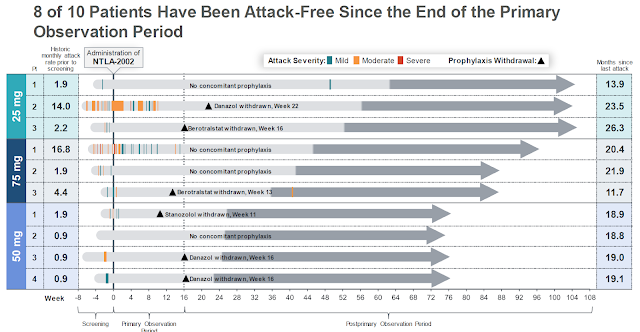
All this is changing as the company is presenting longer-term data strongly suggesting that NTLA-2002 could be a life-time functional cure for many, if not most people living with HAE.

Today, at the EAACI Annual Meeting, Intellia showed that there have been no more HAE attacks since the last update a year ago.  All 10 subjects in this now open-label extension trial have now been attack-free for at least 15 months with a median of almost 2 years.  These 10 patients would have conservatively had around 500 attacks based on their disease history.


500 versus zero, nothing short of a revolution in the management of HAE.  Importantly, with 9 of the 10 subjects having reached 20-30 months after dosing, no drug-related adverse event has been documented after day 28 following NTLA-2002 infusion.

As the data gets better over time, it looks like tonic PKK reduction below a certain threshold may normalize the bradykinin system und put a brake on a neurogenic attack feedback loop.  We know that attacks are frequently triggered by mental and hormonal stress.  In turn, attacks can increase anxiety.  It now looks similar to chronic itch that once the feedback loop is interrupted (HAE attack and scratching) there is a real chance of sustained outcomes.  That this is possible is also illustrated by the fact that people with C1 Inhibitor mutations (the causal mutation in HAE) often do not have any attacks before puberty.

Today’s development illustrates that CRISPR genome editing going after the same targets as competitive modalities can lead to superior outcomes and actually free people from disease instead of keeping them dependent on medicines.  Needless to say, patients are queuing up for the treatment and the pivotal phase 3 trial has been fully enrolled- well ahead of schedule.

Sunday, May 18, 2025

Landmark ATTR-Polyneuropathy Data by Intellia Caps Off Momentous Week in CRISPR Therapeutics

This has been a most remarkable week in CRISPR Therapeutics as momentum continues to build. 

Bespoke therapeutic in 6 months

First, the drug development world and beyond was captivated by the story of how a baby born with life-threatening point mutations in the CPS1 gene was able to receive a bespoke base editing therapy in just 6 months by harnessing the platform potential of nucleic acid-targeted therapeutics and regulators getting out of the way (Musunuru et al 2025). 

Every pharma CEO will be asking her business development underlings about recent underinvestment in the technology when the report shows how development timelines and expenses can be slashed by a factor of 10 when everybody applies ‘common sense’.


I purposely make use of new US administration lingo, because while the CPS1 deficiency story happened under the watch of Peter Marks who was fired as CBER chief because of his involvement in Covid19 mRNA vaccines, there is every reason to believe that drug development will continue to be streamlined by cutting out time-consuming bureaucratic hurdles and applying AI-based document reviews.  Accordingly, Trump's HHS and FDA has repeatedly called for accelerated drug development based on common sense, including biological plausibility.  As further evidence of that, it is phasing out certain lengthy animal toxicology studies.

The most immediate beneficiaries of the story are nucleic acid-targeted therapeutics addressing severe, underserved diseases by harnessing proven delivery and which have a clean off-target profile.  Besides CRISPR-based therapeutics, this also includes oligo-mediated RNA editing which has exquisite on-target specificity and where Rett Syndrome could serve as a template when addressing disease populations segmented by numerous mutations.   


First patient treated with prime editing medicine

Though behind a paywall, STAT reported last week that the first patient had been treated with a CRISPR prime editing agent.  The timing is fitting, as prime editing, by virtue of it being able to address any small mutation, including non-transition mutations and small deletions, is the most universal iteration of CRISPR.  It is also the safest of them all with Prime Medicine claiming no detectable off-targeting for any of its development candidates.

The CPS1 urea cycle story could have been even better if they had used the safer and more effective delivery of VERVE-102 instead of VERVE-101 used by former Verve employee and co-founder Kiran Musunuru.  Also, the base editor in question had not been tested before in the clinic and was selected by comparing a number of adenine base editors in cell lines which also differed in terms of PAM sites and bystander editing.  A prime editing approach by contrast is not subject to PAM constraints as the edit can happen well within a 50 nucleotide window of a given PAM without losing much efficacy.  There is also no bystander editing to worry about.  This way, the same (proven) prime editor mRNA could be used in the same LNP formulation.

The key to quickly applying prime editing in such circumstances would be (AI/machine) learning from the growing dataset of prime editing experiments to find guide RNAs of high efficacy.

Prime Medicine has made great strides towards getting editing efficiencies up to standard Cas9 and base editing levels.  With the first patient dosed, we can expect data in support of that well before the end of the year (2 months for engraftment in the CGD setting).


CRISPR Therapy sets new standard in ATTR-Polyneuropathy

And as if all this was not enough, Intellia today reported 2-year data from their phase I/II study of its Cas9 CRISPR agent NTLA-2001.  Unlike prior TTR knockdown agents by Alnylam (RNAi) and Ionis (RNaseH antisense), key mNIS+7 and Norfolk quality of life measures show that after 2 years of sustained -90% TTR reductions, NTLA-2001 not only stabilizes patients, but the majority of patients improve.  In the dose expansion cohort, there was a clinically highly impactful -8.5 point improvement in mNIS+7. 


Clinically meaningful >4 point improvements were also seen in 5 out of the 6 patients that had been on an RNAi treatment (Patisiran) before.  It is also an improvement over what had been observed at the 12-month timepoint before with NTLA-2001 and sends a strong message:

A one-course treatment permanently changing genetics for the better leads to superior outcomes as the body itself becomes the healing agent. 

I look forward to seeing histology data looking at TTR deposition and whether they start to disappear as the balance shifts towards clearance.

The superior outcome may not come as a surprise when considering that with a 90% gene knockout efficacy, NTLA-2001 halves the amount of TTR being produced following therapy compared to what knockdown agents have been able to achieve.  Still, the fact that improvements seem to accelerate over time is remarkable.

Concordantly, there were no new adverse events and illustrates that acute infusion reactions and possibly transient liver damage around LNP administration is the main safety and arguably only concern of liver-directed CRISPR therapeutics.  Safety challenges arising from having to maintain a certain level of drug concentration, which may e.g. lead to low chronic inflammation and associated transcriptionopathies, do not apply to RNA-/oligo-based CRISPR therapeutics.

With this data, NTLA-2001 should own the ATTR-polyneuropathy market, not just because of its superior efficacy and safety, but also because it is a genetically defined disease and could be given earlier, perhaps even before symptoms manifest.  This would be a hard sell from a health economics point of view for drugs that need to be taken chronically for life.  In the same vein, Intellia reported just yesterday that NTLA-2001 similarly improves the lives of people with genetic ATTR-cardiomyopathy, leading to never seen before increases in the 6 minute-walk-distance measure, not with vutrisiran and not with acoramidis.


Phase 3 studies of NTLA-2001 in ATTR-PN and ATTR-CM are ongoing and should gather steam with the new data.

It is possible that together with the recent PCSK9 data by Verve Therapeutics, last week’s developments and increased signs that regulatory flexibility will continue to be applied if not greatly accelerated by the new administration could mean that the worst for CRISPR investors could be behind.

Wednesday, October 9, 2024

Genome Editing for Hereditary Angioedema Promises a Life Free from Disease Burden

Intellia Therapeutics is about to unveil phase II data on NTLA-2002 at the end of the month.  NTLA-2002 aims to be a one-time treatment for hereditary angioedema (HAE). Prior phase I data looked intriguing with all 10 subjects becoming essentially attack free in the months following (1-time) drug administration and safety findings limited to around the time of treatment.

Still, the study involved too few patients for too short time to clearly define the commercial product in terms of dose, safety, and efficacy (including durability).


HAE is a rare disease with an estimated incidence of 1:10000 to 1:50000 depending on geography. These angioedema attacks are characterized by tissue swelling due to the influx of liquid into tissues through leaky vasculature as a result of bradykinin generation.  With few exceptions, they occur in people due to their genetic lack of C1 esterase inhibitor function.   HAE must be differentiated from allergic edema and as such is not responsive to antihistamines or corticosteroids.

In addition to outwardly visible soft tissue swelling, e.g. of the lips and hands, it can also involve internal systems like the abdomen and lead to excruciating pain.  Suffocation from laryngeal edema is probably the most feared disease manifestation.  It is therefore not surprising that many patients become depressed, stop engaging in normal daily activities to avoid anything that may set off attacks, including stressful situations, physical activity and injury (including surgery). 

Rapid progress in the understanding of the biology behind HAE has resulted in a number of treatments for on-demand and prophylactic uses and significantly improved the outlook for patients.  Still, there is widespread dissatisfaction with the incomplete protection and requirement for regular drug administration of current prophylactic treatments while the utility, convenience, side effects and even embarrassment that come from taking on-demand drugs is being questioned.

Switching between drugs and treatment approach is common and with costs often on the order of $500,000 per annum, access can be a real issue causing additional anxiety.


Enter NTLA-2002

NTLA-2002 promises to address all these challenges. 

That’s a bold statement, but the phase I clinical data provide hints that this could become reality, commercially in 2027 if you are living in the US or even earlier if you decided to and qualified for the global pivotal clinical trial that has just commenced.

NTLA-2002 is a CRISPR-based genome editing treatment that permanently and selectively disrupts the KLB1 gene in liver hepatocytes.  KLB1 codes for plasma prekallikrein (PKK) which is a critical component in the kallikrein-kinin inflammatory system.  Importantly, there are people that naturally lack plasma PKK (Fletcher’s syndrome) or another key component, Factor XII, and these appear to be perfectly healthy.  They are typically only identified by coincidence following routine lab tube tests showing prolonged activated partial thromboplastin time without an actual negative impact on bleeding or otherwise in the natural context.  Deleting KLB1 in the liver should therefore be safe. 

NTLA-2002 comprises of a messenger and guide RNAs entrapped in liposomal nanoparticles (LNPs) similar to the covid mRNA vaccines. Following one-time intravenous administration, these traffic to the liver hepatocytes where the guide RNA directs the CRISPR Cas9 enzyme to disrupt the KLB1 gene. 

Such a formulation already exists commercially in the form of ONPATTRO.  ONPATTRO is an RNAi therapy that is administered every 3 weeks.  Similar to the phase 1 study of NTLA-2002 (Longhurst et al 2024), transient immune suppression (corticosteroids, antihistamines) is practiced around the i.v. administration.  The great thing about NTLA-2002 is that the side effects from this procedure are well recognized and managed and would only present once- if at all.

As mentioned above, all10 subjects in the dose-ranging phase I study of NTLA-2002 have essentially become attack free once the medicine had a chance to do its work, destroy hepatocyte KLB1 and normalize the kallikrein-kinin-system.  This indicates that after the optimal dose has been found, a good number of HAE patients may go on with life and forget about their disease!  So patients may not only enjoy the best efficacy of any HAE treatment, they would only have to take it once.


The phase II study results will more than triple the number of patients that have been (hopefully successfully) exposed to NTLA-2002 and thus provide a good basis for the dose chosen to undergo confirmatory phase 3 testing.  Based on recent statements, the company will select the 50mg dose which in the phase I study gave -88% plasma PKK reduction, a level well above the -45% reduction where HAE attack rates start to drop off precipitously (Riedel et al 2024).   

For those that continue to experience a rare attack, it may be possible to give another dose of NTLA-2002.  Data from another (monthly administered) antisense oligonucleotide therapeutic (donidalorsen) targeting the same PKK gene indicate that attack rate reduction and PKK inhibition are tightly correlated (Riedel et al 2024).  It is therefore conceivable that once plasma PKK drops below a critical concentration in the blood, swelling attacks are virtually eliminated.  A presentation at the upcoming ACAAI meeting by the sponsor of donidalorsen, Ionis Pharmaceuticals, should further shed light on this.    

Medical innovation is costly and NTLA-2002 which promises to be the second approved CRISPR genome editing therapeutic following Casgevy for sickle cell disease will be no different.  Given the rarity of HAE, it would not be surprising if it cost 2 to 3 million USD for treating a patient.  This compares to other medications in the space, including Cinryze or Takzhyro, which often carry annual price tags exceeding $500,000.  Sure, healthcare administrators are likely to throw up their hands and have sticker shock, but simple math shows a one-time treatment to be a real money saver for patients that have decades of disease-free lives in front of them. 

Disclosure: this is not medical advice. Always talk to your HAE specialist doctor first before making a treatment decision.

By Dirk Haussecker. All rights reserved.

Disclaimer: This blog is not intended for distribution to or use by any person or entity who is a citizen or resident of, or located in any locality, state, country or other jurisdiction where such distribution, publication, availability or use would be contrary to law or regulation or which would subject the author or any of his collaborators and contributors to any registration or licensing requirement within such jurisdiction. This blog expresses only my opinions, they may be flawed and are for entertainment purposes only. Opinions expressed are a direct result of information which may or may not be accurate, and I do not assume any responsibility for material errors or to provide updates should circumstances change. Opinions expressed in this blog may have been disseminated before to others. This blog should not be taken as investment, legal or tax advice. The investments referred to herein may not be suitable for you. Investments particularly in the field of RNAi Therapeutics and biotechnology carry a high risk of total loss. You, the reader must make your own investment decisions in consultation with your professional advisors in light of your specific circumstances. I reserve the right to buy, sell, or short any security including those that may or may not be discussed on my blog.