Pages

Showing posts with label VERVE-102. Show all posts

Tuesday, June 17, 2025

CRISPR Stocks in Wake of Verve Therapeutics Acquisition by Eli Lilly


Last night, news broke that pharma giant Eli Lilly was in talks to acquire Verve Therapeutics.  After a 3-year lull in major CRISPR dealmaking following the Covid bubble, this brings the space the Big Pharma validation that genome editing is not a crazy fantasy, but a core modality of future drug innovation. To my surprise, even hardcore biotech investors had been waiting for such validation before considering the space investable. 

Needless to say, the news will trigger pin action in other CRISPR stocks.  In this blog post, also based on a similar experience I had in the RNAi space about 10 years ago, I will lay out how I see it play out,  

Verve acquisition is a steal

As you will remember, Verve is developing an exciting one-time PCSK9 base editing treatment, VERVE-102, that could transform LDL-cholesterol-driven atherosclerotic cardiovascular disease (ASCVD).  According to the rumors in the Financial Times the proposed acquisition price is ~$1.3B.  This would be a bargain considering the potential of VERVE-102. 

Even with the current small available safety dataset, it is hard for me not to see VERVE-102 as a highly compelling option for the 1-2 million heterozygous familial hypercholesterolemia (heFH) population in the US and Europe alone.  Slap on that a $100,000 treatment price, this alone has Glp1-type market dimensions.

Under normal market conditions, such a steal would not be possible.  But these have been anything but normal biotech investment times. I believe that more than the nice short-term financial reward of an acquisition, Verve management is doing here what is best for VERVE-102 reaching its maximal potential.  Ultimately, it takes the financial resources, experience, and credibility of a pharma giant to develop and commercialize such a revolutionary treatment to such a big market.  

Who is next?

But luckily for investors, Verve Therapeutics has not been the only severely undervalued CRISPR company.  When Alnylam started to gain tremendous traction in 2012-3 after demonstrating that you can make RNAi gene silencing work in humans, still working as a consultant to companies and investors back then, I noticed how funds started to dig into who could be the next Alnylam to invest in.

So on the back of very strong recent clinical data in the space (VERVE-102, NTLA-2001/2, BEAM-302) and now the Big Pharma validation, I expect the same dynamic to unfold here.

Intellia Therapeutics

The first obvious company to benefit from fund inflow should be Intellia Therapeutics.  Verve Therapeutics will be acquired mostly for a therapeutic candidate that has shown promise in the clinic. Intellia therefore with not just one, but three clinically validated market opportunities (ATTR-CM, ATTR-PN, HAE) and a reasonably large market cap of around $900M and good trading liquidity for funds to take needle-moving positions in, will come first on the radar.

What is more, almost the entire market cap can be accounted for by its cash position and the stock has come down from a high of around $200 4 years ago to $9.  The main reservation by the investor community has been that patients will prefer a daily pill over a futuristic-sounding lifetime treatment, if not cure.  I guess they were wrong.  Not only is Eli Lilly’s proposed acquisition a vote of confidence in CRISPR modality, but the KOLs in the ATTR and HAE field are already fully on board.

Beam Therapeutics

Beam with a market cap about 2x of Intellia’s will also come into investor focus.  While I do have a small position in that company, it is by far not as big as the one I have in Intellia.

This is because I consider uncertainties around its two lead candidates, for sickle cell disease (SCD) and alpha-1-antitrypsin disease (AATD), to be higher than for Intellia’s opportunities.  Their sickle cell disease base editing should be superior to that of already approved Casgevy by Crispr Therapeutics and Vertex Pharmaceuticals. 

But will that be enough for the ex vivo autologous hematopoietic stem cell approach to gain quicker commercial traction than Casgevy?  With regard to BEAM-302 for AATD, I am still waiting for more clarity on the liver safety of their (non-GalNAc) LNP.  It was the new safety standard set by VERVE-102 (GalNAc-targeted and ‘Novartis ionizable lipid’) that makes VERVE-102 a viable therapeutic in the first place.

Prime Medicine

Having just cured p47phox variant chronic granulomatousdisease (CGD) which could entail a valuable priority review voucher, Prime Medicine is now focusing on the relatively large severe genetic liver disease opportunities of Wilson’s Disease and AATD.

While not as clinically advanced as Beam Therapeutics, Prime Medicine has the benefit of learning from the LNP safety of the Intellia, Beam, and Verve programs.  I therefore expect them to bring forward a lower-risk GalNAc-enabled LNP similar to Verve’s when it enters the clinic next year.

From a platform point of view, prime editing is the future of CRISPR medicine due to its versatility and exquisite on-target specificity.  Prime Medicine with a dominant IP position in prime editing, a market cap of $200M, much of which in cash, is therefore a prime candidate for a Big Biotech/Pharma looking to make use of that technology for its in-house targets.

Metagenomi

Going nowhere in its clinical pipeline, but generating new, especially smaller CRISPR editors that could have delivery and immunologic advantages, is Metagenomi.  Its lead candidate is a CRISPR-enabled gene drop-in approach for hemophilia A (MGX-001) which it hopes to bring into the clinic in 2026.

While I consider Metagenomi’s gene drop-in data to be industry-leading, there are questions around its safety profile since it will involve not only LNP, but also AAV for systemic delivery.  So while MGX-001 could be the first ‘gene therapy’ for hemophilia with sustained transgene expression, Metagenomi’s valuation will unlikely get recognition for it until actual clinical data.

The main reason why Metagenomi is interesting here is that it is not only trading 70% below cash ($55M market cap, $200M cash), but that it has an important partnership with Ionis Pharmaceuticals which could view CRISPR as an increasingly important mechanism to shore up its commercial ambitions in ASO-led franchises such as ATTR, HAE, and cardiovascular disease.

If I were Ionis Pharmaceuticals, I would just buy Metagenomi for $200M, retire preclinical MGX-001 for little cost and thus get rid of my future milestone and royalty obligations.  Of course, Ionis may prefer Prime Medicine for its more versatile technology.

Buying a platform-only company in this biotech tape is certainly not for the faint of heart and large funds will shy away from Metagenomic at least initially due to its small size and illiquidity.  I can see it, however, emerge as an attractive second-wave opportunity should interest in CRISPR stocks be sustained enough.  As a backstop, you still have Ionis Pharmaceuticals having to make a decision on investing further into Metagenomi later this year.

You may ask yourself why I have not mentioned the biggest CRISPR company by market cap, $3.6B CRISPR Therapeutics.  This is because of initially overoptimistic expectation for Casgevy sales and with their recent RNAi deal spreading themselves out too thinly and losing their cutting edge so early in the game.  I would also like to see them disclose the liver safety before attributing value to their first generation Cas9 nuclease-based cardiovascular CRISPR franchise.


Disclosure: Verve Therapeutics became my largest portfolio position after they disclosed VERVE-102 data two months ago.  While smaller than my positions in Huntington’s disease gene therapy company uniQure and RNA editing company ProQR, Prime Medicine and Intellia Therapeutics are not far behind and very meaningful positions with close to 10% portfolio weightings.

This is not financial advice.  It is intended for those interested in contemplating the stock market repercussions of the rumored Verve Therapeutics acquisition.  Buying a stock is the simple part, successfully trading it for profit much more difficult. 


Tuesday, May 27, 2025

First Commercializations of Systemic Therapies as Backstop for CRISPR Investors

There is widespread consternation about the disconnect between recent clinical breakthroughs and the performance of CRISPR-related stocks.  I am highly confident that this will correct by mid-2027 at the latest when NTLA-2002 should become the first systemically administered CRISPR therapeutic to be commercialized.  It will demonstrate the high demand by patients and physicians for this revolution in medicine and commercial viability.


KOL enthusiasm

In 2017 at the iconic Paris ATTR Amyloidosis Meeting where Alnylam unveiled the biggest clinical breakthrough in RNAi, the eyes of key opinion leader Dr Julian Gillmore (UCL) lit up when going another step forward into the future, talking about the promise of one-dose CRISPR genome editing for the disease.  This was notable since he is essentially involved in all the key clinical programs in ATTR amyloidosis irrespective of modality, including TTR stabilizers and RNAi silencing.    

I noticed similar genuine enthusiasm at last year’s ACAAI meeting from hereditary angioedema (HAE) KOL Dr Banerji (Harvard) regarding NTLA-2002 after experiencing NTLA-2002 in her own patients.  Another seeing-is-believing moment was recently voiced by Prof Patel of UCL, an investigator in the VERVE-102 PCSK9 base editing trial:

 “This is reality; it’s not science fiction. We’re actually doing it. I’ve had patients of mine in the trial receive this one-and-done treatment, and it’s going to change the face of cholesterol management going forward.”

I have yet to see a single trial investigator or KOL who has deeply thought about the implications of one-time therapies in clinical development for the above diseases and discarded them as freakish or irresponsible as people invested in competing therapies like to do.


Patient enthusiasm

The same holds true for patients, that is the people whose voice should have the most weight in the discussion on the risk/benefits and ethics of genome editing. 

In a patient preference survey commissioned by Verve Therapeutics, one third already stated that a one-time genome editing treatment would be more appealing to them than daily pills or injectible drugs.  I expect this number to further increase as VERVE-102 makes its way through the clinic and first patients get treated commercially (word of mouth will be tremendous). 


Similarly, HAE patients confronted with NTLA-2002 look to it with hopes of allowing them to forget about their disease and not having to worry about getting repeat-administered drugs covered by insurance in perpetuity.  Accordingly, enrolment in the phase 3 HAELO trial is extraordinarily swift as patients are lining up for NTLA-2002 according to Intellia Therapeutics.


But what about payors?

Besides public acceptance of CRISPR genome editing, cost for these one-time therapies is often brought up as an argument against CRISPR.  Surely, they will be prohibitively expensive.  Why for example would anybody pay $2M for ATTR-drug NTLA-2001 when you can get the RNAi alternative for just $500k annually.  Sure, some people will rent the child booster from the rental car company at $20 a day, instead of buying one from a Walmart around the corner for the same price.

If anything, it is CRISPR Therapeutics that have the pricing power in most settings, including for mass markets like cholesterol lowering (--> VERVE-102).  The vastly superior outcomes in terms of morbidity and mortality projected for life-long LDL cholesterol lowering, especially when initiated early on, should more than compensate the $100k or so price tag I expect it to carry initially.  There is also a noticeable shift in the new US administration towards preventing rather than treating disease.  No better modality than genome editing for that as long as the delivery and gene target is safe.

In the words of Stanford’s genome editing scientist Matt Porteus at the 2025 Copenhagen CRISPR conference, the US insurance system is 'f*cked up', but with many eyes nowadays on how the insurance and PBM industry deals with access (see United Health) and the aforementioned inherent pricing power of (non-viral) genome editing, payors will not meaningfully stand in the way of these therapies.  Similarly, the new modality should run into open doors with Medicare and Medicaid who are most vested in the long-term outcomes of covered lives.


Momentum building

With NTLA-2002 likely wrapping up enrolment in Q3, we should see the first commercialization of the promising crop of systemically administered CRISPR drugs in mid-2027.  NTLA-2001 for ATTR-PN, BEAM-302 for AATD, VERVE-102 for heFH and high-risk ASCVD, and finally NTLA-2001 for ATTR-CM should follow in 2028/9.  When the sales numbers finally come in, even the longest naysaying hold-outs will have to admit defeat and CRISPR stocks should rebound.  This could be greatly catalyzed if that happens in a lower interest rate environment (Powell will be replaced in 2026).


But even before that, the steady stream of recent clinical successes (VERVE-102, urea cycle N=1 base editing, NTLA-2001 ATTR-PN data at PNS, BEAM-302 initial data) have led to increased broader interest in CRISPR with large social and traditional media accounts talking about the technology once again.  If industry validation is what you are looking for, with Regeneron and Eli Lilly having to make their respective NTLA-2001 and VERVE-102 opt-in decisions soon and share prices dangerously low, we could see ‘strategics’ stepping in.  The dam could break any day, in a positive way, for long-suffering investors.

Monday, April 28, 2025

China Fast-Follower Competition Reaches Clinical CRISPR

There is panic among Western biotech that Chinese competitors will eat their lunch with their capital-efficient fast-follower strategy which typically involves rapid clinical translation via investigator-initiated trials.  This issue has now reached the CRISPR space in the form of first clinical data announced by YolTech regarding a PCSK9 base editing trial for the treatment of hypercholesterolemia.

Almost identical to pioneer Verve Therapeutics which reported stellar data earlier this month (discussed here), YolTech’s YOLT-101 formulation involved a GalNAc-LNP encapsulating an adenine base editor mRNA and guide RNA targeting a splice site of the PCSK9 pre-mRNA for gene knockout.  The more detailed nature of the LNP formulation was not disclosed in the accompanying medRXiv publication.   

The trial tested 3 dose levels of YOLT-101: 0.2mg/kg (n=1), 0.4mg/kg (n=2), and 0.6mg/kg (n=3) indicating an unusually rapid move up in the dose level by international standards.  Efficacy was only reported for one subject treated with 0.4mg/kg and the three 0.6mg/kg subjects with heterozygous familial hypercholesterolemia.

Similar to Verve Therapeutics, LDL-cholesterol lowering was roughly -50% for 0.6mg/kg.  Unfortunately, the information provided did not allow for an analysis of the relationship of total dose of YOLT-101 and LDLc reduction.  On the PCSK9 front, YolTech seemingly did better than Verve Therapeutics reaching a mean of -76% versus the -60% for VERVE-102 both at 0.6mg/kg.


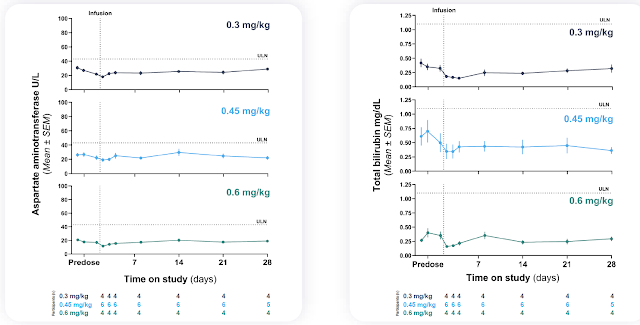
This, however, is where the similarities ended.  In terms of the critical safety of a potentially very widely applicable therapy, 3 out of the 6 subjects treated with YOLT-101 exhibited ‘transient elevations in ALT and AST’ that ‘almost’ returned to normal within one month.  Furthermore, 5 of 6 subjects experienced infusion-related reactions involving fever, myalgia, and vomiting. And similar to Verve’s ill-fated VERVE-101 formulation, one subject at the 0.4mg/kg dose experienced chest pain shortly after LNP infusion.


Nevertheless, the authors noted that the trial remains ongoing to ‘validate the therapeutic durability and safety profile’.  Considering the ALT/AST elevations for which more detailed values were not disclosed, it seems questionable whether this is an ethical decision.  Add to this the rapid dose escalation and selective data disclosures, it provides fodder to those criticizing China for allowing human experimentation and Big Pharma taking advantage of it by licensing therapeutic candidates built on such strategies on the cheap, not even mentioning the intellectual property issues of ‘Chinese Beam Therapeutics’


Monday, April 14, 2025

Verve Therapeutics Nails Cardiovascular Disease CRISPR Study

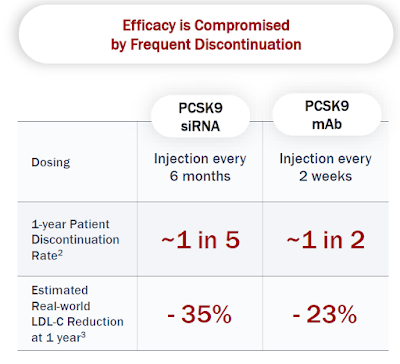
Patients do not benefit from drugs they do not take.  This is especially true in the cardiovascular disease space aimed at lowering atherogenic LDL-cholesterol where the majority of patients starting on oral options like statins do not take their pills after just one year.  This is also true for once every 2 to 4 weeks next-generation PCSK9 antibodies and even semiannual PCSK9 RNAi therapeutic inclisiran, though to a lesser degree in the latter case.


With this realization in mind, Verve Therapeutics set out to develop a PCSK9 CRISPR base editing treatment that should lower LDL-cholesterol for life by at least -40% after just a single administration of an intravenous LNP formulation.  Unfortunately, a first generation formulation, VERVE-101, had to be abandoned a year ago because of laboratory abnormalities, in particular ALT/AST elevations 5 to 10-fold above the upper limit of normal as well as a case of dangerously low platelet counts in a first clinical trial.  In addition, the intra-dose variability of the PCSK9 knockdown and LDLc lowering between subjects and the dose-responsiveness were not optimal.


Liver enzyme elevations (here ALT) with VERVE-101 in the HEART-1 study

All evidence pointed towards the LNP formulation, not the PCSK9 as the target or the base editing process, to be the culprit for the safety issues.  Verve therefore decided to replace some of the lipids in the liposomal formulation and add GalNAc sugars so as to allow the LNP to be taken up by both the LDL-receptor (via ApoE)- and ASGPR (via GalNAc).  This is helpful for two patient populations that are most in need for new treatment options and which lack LDL receptors (heFH and hoFH).  The base editor and guide RNAs were left unchanged from VERVE-101. 

Based on data from the first 14 subjects treated with VERVE-102 revealed today the theory translated perfectly into clinical practice.  At doses above 50mg of the LNP, the mean LDLc reduction was -59%, in line with the most potent PCSK9 agents (antibodies) and significantly more potent than inclisiran, especially in the heterozygous FH (heFH) population.  Moreover, there was a beautiful dose response for both PCSK9 and LDLc lowering and very little inter-patient variability.


Dose-related LDLc lowering in the HEART-2 trial with VERVE-102


Even more importantly, the safety was pristine.  There was hardly a blip with no outliers in terms of ALT/AST changes upon LNP administration, a stark difference to VERVE-101.  Similarly, no platelet changes were seen.  Only a single case of grade 2 infusion reaction was observed which rapidly resolved and does not pose an obstacle to further clinical development and commercialization.  Anybody familiar with LNP technology understands that GalNAc-LNPs are now the gold standard in the delivery of genome editing in the liver.


Verve Therapeutics is wrapping up the HEART-2 study with a final higher dose to see whether there is further LDLc lowering and then proceed to a ~60-subject phase II study aimed at locking down one of two fixed doses of VERVE-102 for the registrational phase of clinical development.

Today marks a milestone in moving genome editing to large, indeed very large patient populations. 


Disclosure: I owned some Verve Therapeutics shares going into data and doubled down on it after seeing the emerging VERVE-102 product profile.


By Dirk Haussecker. All rights reserved.

Disclaimer: This blog is not intended for distribution to or use by any person or entity who is a citizen or resident of, or located in any locality, state, country or other jurisdiction where such distribution, publication, availability or use would be contrary to law or regulation or which would subject the author or any of his collaborators and contributors to any registration or licensing requirement within such jurisdiction. This blog expresses only my opinions, they may be flawed and are for entertainment purposes only. Opinions expressed are a direct result of information which may or may not be accurate, and I do not assume any responsibility for material errors or to provide updates should circumstances change. Opinions expressed in this blog may have been disseminated before to others. This blog should not be taken as investment, legal or tax advice. The investments referred to herein may not be suitable for you. Investments particularly in the field of RNAi Therapeutics and biotechnology carry a high risk of total loss. You, the reader must make your own investment decisions in consultation with your professional advisors in light of your specific circumstances. I reserve the right to buy, sell, or short any security including those that may or may not be discussed on my blog.