Pages

Showing posts with label ProQR. Show all posts

Tuesday, February 18, 2025

Increasing the Reach of ADAR Therapeutics by Protein Structure Prediction

'Only' being able to convert an ‘A’ to an ‘I’ when genome editing can seemingly re-write the code at will had been seen as a major limitation of the technology.  Examples such as the large and underserved market in correcting the piZZ genotype in alpha-1-antitrypsin disease using A-->I RNA editing were the exception.  With the help of artificial intelligence-enhanced structure prediction tools, however, the financial incentive to pursue genetic disease should increase again.  Indeed, ProQR’s first Rett Syndrome candidate already points in this direction.


Addressing the p.R270X mutation

Rett Syndrome is an X-linked dominant genetic haploinsufficiency neurological disorder caused by mutations in the MeCP2 protein leading to decreased functional activity as a master regulator of gene expression and neuronal development.  There are many ways to cause the loss of activity of a protein, so mutations can typically be found throughout an affected haploinsufficiency gene.

ProQR’s 1st candidate for Rett Syndrome addresses the p.R270X mutation where the arginine codon CGA at position 270 in the protein is mutated to the stop codon UGA, thus leading to a truncated protein that is also destabilized at the mRNA level via the NMD pathway.  Luckily, the CGA codon contains an actionable ‘A’ and although editing it to a G-like Inosine would not restore the wild-type protein, it happens that mice with tryptophan-coding UGG at position 270 behave like rescued wild-type mice.


Beyond p.R270X

It is well established that a second mutation can modify, if not rescue a disease caused by a first mutation.  At a protein level, this may be due to functional restoration by coaxing the protein back to its original functional structure.  

Rett Syndrome affects around 50,000 females in the US and EU of which ~3,500 would be due to p.R270X.  Point mutations across the MeCP2 gene overall account for 60% of cases. Such numbers are too low for one to expect to come across compensatory mutations in the MeCP2 from population genetics.  So instead of relying on serendipity one may systematically ask whether the structural pathological change resulting from a given point mutation or group of point mutations (characterized for example by destabilization of the DNA-binding domain of MeCP2) could be reverted back towards wild-type if one ADRA edited one of the ~350-400 Adenosines in the MeCP2 mRNA based on AI-powered structure prediction tools like AlphaFold.

This could then be verified by a cellular functional assay of MeCP2 as a master epigenetic regulator.  Regarding approval and clinical trial population, a label may just say that a patient with a very rare mutation that could not be confirmed in clinical trials due to low subject numbers may still qualify for the drug as long as such an assay supported it.  This path has already been trodden, for example with Vertex’ Cystic Fibrosis drugs.


AI increases IP value around platform drug modalities

Artificial intelligence is an amazing development.  The above strategy is just one example of how it may decrease future drug development cost and efficiency, thus increasing the attractiveness of going after rare diseases again.  I would not be surprised therefore if structure prediction may help to address the most common missense mutation in Rett Syndrome, p.R106W, which affects 3x the patient number of p.R270X.  

There are, of course, many more applications also to RNA editing such as chemistry based on structure prediction around the A to be edited when paired to the editing oligo. 

AI, however, is also a scary development for people like me.  When I came across this concept, it seemed like Gemini had it all figured out already.  I fully expect that in a year’s time, I will have to re-think the point of blogging full-stop when AI can tell for itself which are the more or less valuable concepts.  One thing is sure, AI will open the flood-gates for therapeutic strategies leveraging genetic platform technologies like ADAR, RNAi, antisense, CRISPR and gene therapy.  Investing in companies with fresh, gate-keeping IP in these technologies could therefore more valuable than ever.  It is therefore possible that sooner than later I will be watching all this from the beach as a passive investor in these platforms.  


Friday, July 14, 2023

Korro Bio To Become Third Publicly Listed ADAR Editing Company

Today, pure-play ADAR Editing Korro Bio announced that it will reverse merge into biotech shell Frequency Therapeutics (current ticker: FREQ, to be changed to KRRO).  It will thus become the 3rd publicly traded RNA Editing company following ProQR (pure-play) and Wave Life Sciences, the latter entertaining a broader mix of oligonucleotide therapeutics modalities (ADAR editing, exon skipping, RNAi).

Following two private founding rounds of ~$210M in 2020 and 2022, the transition into the public markets which is being accompanied by another $117M cash injection from mainly existing venture backers led by Surveyor Capital and Cormorant Asset Management, is to prepare the company making the transition to the clinic.  Its lead candidate is to address both the lung and liver manifestations of alpha-1-antitrypsin disease (AATD) caused by the prevalent piZZ genotype.

Today’s development explains their surprising announcement earlier this year to adopt liposomal delivery instead of GalNAc-targeted chemically modified oligonucleotides as is practiced by industry leaders ProQR and Wave Life Sciences.  Without the prospect of a clinical candidate, such an ‘IPO’ would not have been possible. 

As I had noted in an earlier blog entry though, such a development candidate is likely to fail both from a clinical and commercial point of view.  Firstly, for AATD patients at high risk of liver disease or actually manifesting liver disease, a chronically administered LNP seems like a bad idea. Indeed, Korro Bio today revealed significant liver enzyme elevations in animal models at doses (2mg/kg) that are likely required for robust SERPINA1 editing and are substantially higher than what is used for the clinically approved MC3-based LNP formulation Patisiran in ATTR amyloidosis by RNAi Therapeutics company Alnylam.


From a competitive point of view, the LNP approach suffers from the need of frequent, possibly weekly intravenous infusions whereas less frequent (I expect monthly) subcutaneous administration schedules should be feasible with Wave’s first clinical GalNAc editing oligo and possibly less frequently as oligo chemistry advances (similar to RNAi).  As Wave is likely to be a year ahead of Korro in the clinic, this alone makes it a head-scratcher approach for a fast-follower.

As we have learned from the RNAi Therapeutics field, further stabilizing Korro’s oligonucleotide is unlikely to extend dosing frequency as LNPs release most of their cargo into the cytoplasm almost instantaneously whereas the long duration of action by oligo-conjugates is explained by their gradual release from endosomes.

There is one scenario, however, where I can see Korro Bio’s candidate to have staying power, namely in being the only approach among the ADAR Editing and CRISPR genome editing and gene therapy candidates that can successfully treat both the lung and liver manifestations of AATD by achieving >90%-type editing levels.  As we have learned from Arrowhead Pharmaceuticals' liver AATD program (partnered with Takeda), even with near complete removal of toxic alpha-1-antitrypsin expression in the liver, prolonged treatment will likely be necessary to see a robust clinical response (phase 3 involves >3 years of dosing).

It is for this reason that I view the ADAR and genome editing approaches mainly aimed at those suffering from lung disease (which RNAi cannot address), including those with mixed phenotypes.  I will discuss clinical development landscape further in my next blog entry.

What I most like about Korro Bio, a prolific IP filer, is their mix of ADAR Editing programs encompassing genetic correction for AATD and Parkinson’s (LRRK2), anti-protein aggregation (TDP43 in ALS), modulating ion channel (NAV1.7 in pain), disrupting protein-protein interaction in alcoholic hepatitis and activating kinases.  But to extract the full value from applying RNA Editing to these attractive disease areas, Korro Bio needs to catch up on oligonucleotide chemistry and designs.


Saturday, April 29, 2023

Roche Impresses with Effective RNA Editing of Polyglutamine Repeat mRNA

Roche has shown interest in RNA Editing through its 2021 partnership with Shape Therapeutics.  The goal of this partnership was to use Shape’s AAV-delivered, DNA-directed RNA editing nucleic acids for neuroscience and rare disease applications.

Readers of this blog will know that I have not been a great fan of DNA-directed approaches to ADAR editing, not least because the expressed editing RNAs are unmodified.  This means that they do not benefit from chemistry to optimize efficacy.  In terms of specificity, the simple, but very effective strategy of modifying the base opposite non-target adenosines (e.g. 2’-O-methyl) to abolish off-target editing is not available to DNA-directed RNA editing.  

To compensate the efficacy disadvantage, the concomitant gene therapy-directed overexpression of ADAR enzymes has been attempted.  Unfortunately, this is a no-go since it causes extensive genome-wide off-targeting.  

It therefore comes as no surprise that Roche has also been evaluating synthetic editing oligonucleotides as revealed earlier this month in patent publication WO2023/052317A1.  This patent application addresses CAG/polyglutamine repeat expansion diseases such as Huntington’s disease, but also other neurodegenerative polyGln diseases including a number of the spinal cerebellar ataxias.  Since the number of polyGln repeats critically determines whether a person will manifest the disease and is correlated with protein aggregation, disrupting stretches of CAG-encoded uncharged glutamines with even a few positively charged, CGG-encoded arginines may stop the pathogenic process and is thus a highly attractive therapeutic hypothesis.

Beyond CAG triplett expansion diseases, similar logic may apply to diseases caused by repeat expansions in non-coding regions- as long as the repeat contains an ‘A’ such as in Friedreich’s ataxia (frataxin GAA repeat in intron 1).  Regardless of the specific disease-causing mechanism, disrupting the repeat is likely to be beneficial.  

While attractive in theory, I had been wondering how easy it actually would be to target these repeats by ADAR editing as the target sequence is quite unusual in its repetitiveness which may result in impenetrable higher-order structures.  The use of repetitive oligonucleotides as therapeutic agents is also unusual because of potential structural and manufacturing issues.  Finally, once one of the target adenosines has been converted to an inosine, the target mRNA sequence is altered (=mismatch) and consequently may become a weaker target site.

On the other hand, long repeats may turn out to be excellent targets in that they provide for a high local concentration of target sequence.

Actual data

Unfortunately, conducting casual molecular biology experiments in the basement of private homes is frowned upon in Germany and fraught with legal risks (this has to change), so it’s nice that Roche has actually conducted initial tissue culture experiments to find out about the practicality of the approach. 

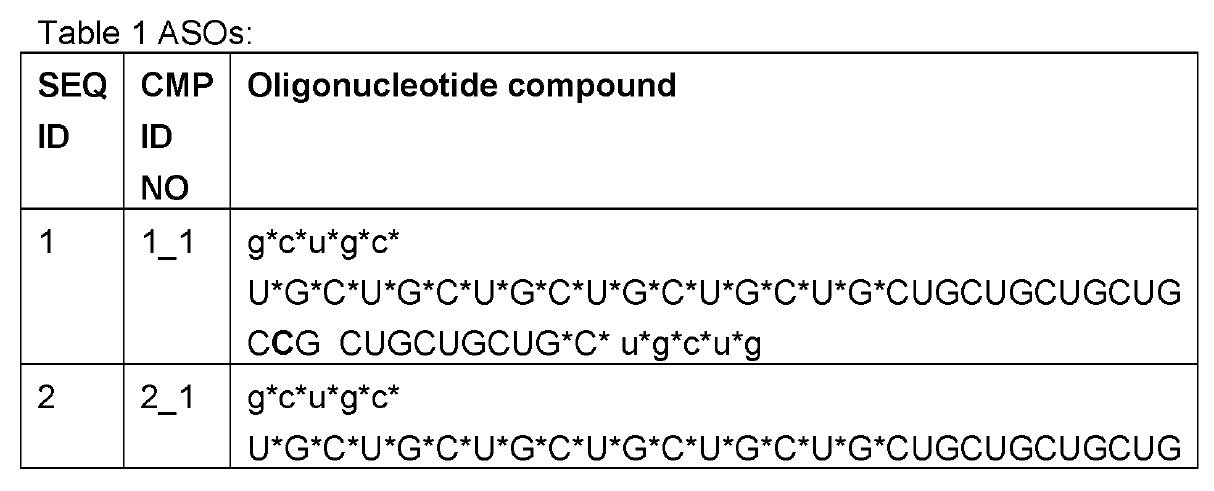
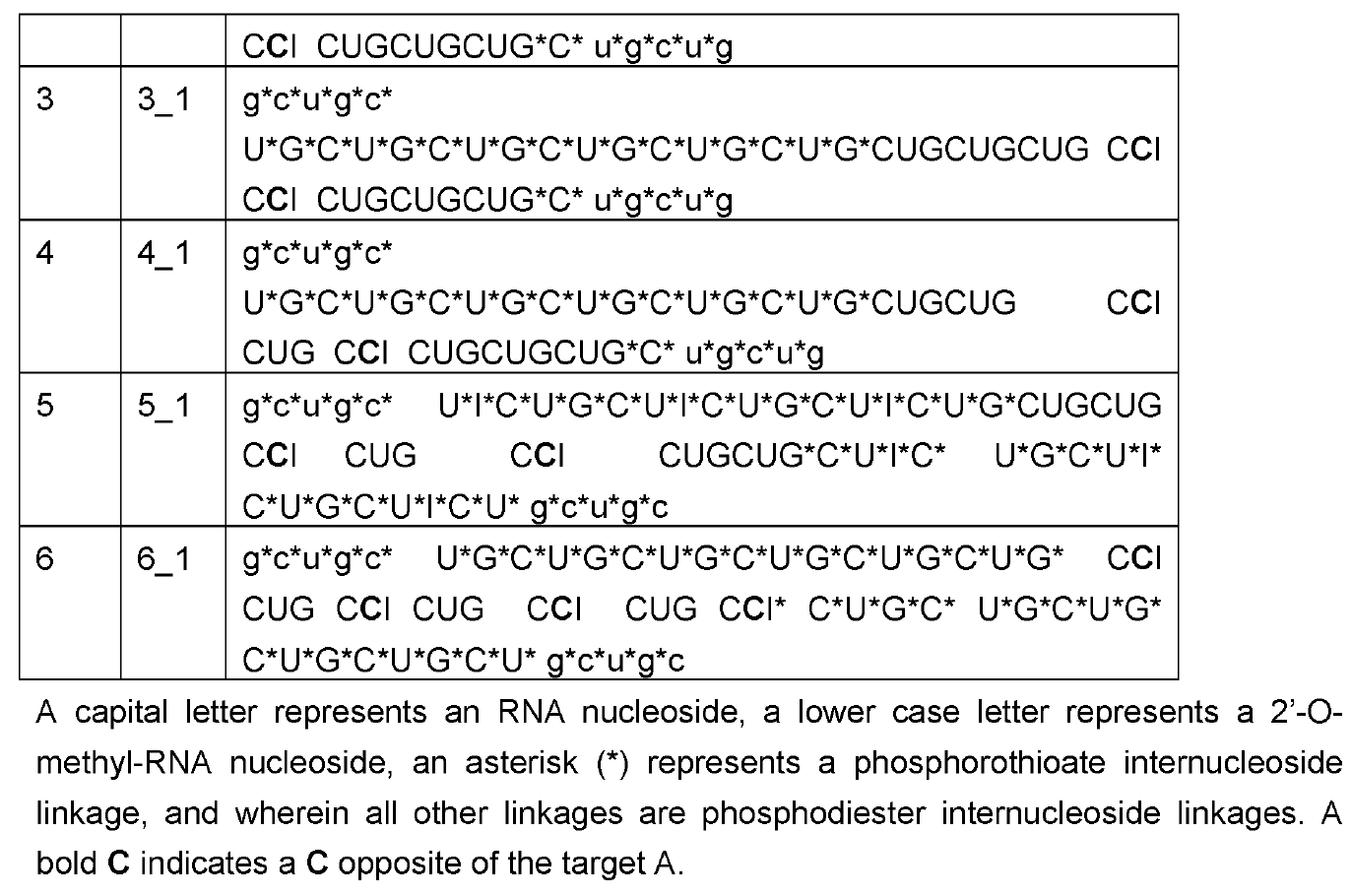
Employing ~50-60nt long CUG repeats (the complement of CAG), their editing oligonucleotides were above the typical length of ~30nt as now generally practiced by the leading RNA Editing companies ProQR and Wave Life Sciences.  These were transfected into HeLa cells expressing ATXN3 mRNA with 21-22 repeat CAGs all in the apparent absence of ADAR overexpression.  

The oligonucleotides were modified with 2’-o-methyl only in the 5 nucleotides on the 5’ and 3’ ends each; phosphorothioation of the backbone was also practiced at the wings of the oligos, but extended further into the center than the 2'-o-methyls.  The central part consisted of pure RNA. 


An orphan C was placed towards the 3’ end of the targeting oligo.  This creates a mismatch to the target A as is commonly practiced in the field.  Interestingly, an inosine follows 3’ of the orphan C and this is also practiced by some other companies as e.g. evidenced in last year’s high-profile paper on long-lived and potent ADAR editing in non-human primates by Wave Life Sciences in Nature Biotech.

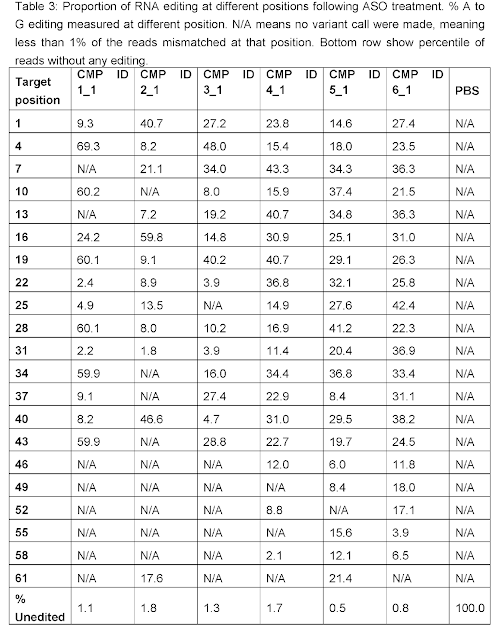
Remarkably, robust 20-50% AàI conversions were seen for many As in the ATXN3 CAG repeat with more pronounced editing towards the 5’ end of the repeat region consistent with the 3’ placement of the orphan C in the targeting oligonucleotide.  Moreover, less than 2% of the ATXN3 mRNAs was unmodified for each editing oligo.  If you consider that a huntingtin allele with say 33 CAG repeats does not result in Huntington’s disease, but one with 37 repeats typically does, you can imagine the impact that just a single or two successful editing events should have on pathogenicity of the resulting protein.


This experiment thus is an important de-risking step for RNA Editing in repeat expansion diseases and should whet the appetite of Roche which is already heavily invested in oligonucleotide therapeutics for Huntington’s through its collaboration with Ionis Pharmaceuticals (RNaseH mechanism), including research on improving the convenience and efficacy of intrathecal oligo administration.

As an investor in ProQR I was, of course, pleased to see that when discussing the prior art of ADAR editing in general, all 5 patent applications cited by Roche referred to ones controlled by ProQR. 

Looking forward to the next chapter in this story.

Tuesday, April 4, 2023

ProQR and Partner Eli Lilly Demonstrate Oligonucleotide-induced RNA Editing in the CNS: A Major De-risking Event for the Industry

With every new oligonucleotide therapeutics modality that feeds into an endogenous cellular mechanism comes uncertainty as to whether the mechanism is sufficiently robust to be of therapeutic utility.  

This is especially true for RNA Editing as in its early days targeted AàI editing was only shown with the concomitant DNA-directed overexpression of ADAR along with an targeting RNA or the introduction of recombinant ADAR-antisense conjugates of little direct therapeutic use.  Similarly, simply introducing into a cell a chemically synthesized antisense oligonucleotide hybridizing to the area surrounding the target adenosine in an mRNA will only give you minute editing efficiencies in cell culture without further structural and chemical optimization.

The liver and CNS, due to their gene target richness and the demonstrated clinical feasibility of delivering oligonucleotides to these organs, are of particular importance to the RNA Editing industry.  The demonstration byscientists from Wave Life Sciences of oligonucleotide-directed RNA Editing in non-human primates was therefore an enormous de-risking event in that it showed that RNA Editing is sufficiently robust in living primate livers.

Of similar importance was the revelation by ProQR and their partners from Eli Lilly last week that this also holds true for the primate nervous system following the intrathecal administration of an editing oligonucleotide.  10-30% editing were seen in the brain depending on the anatomical location investigated.  In both the mice (intracerebroventricular delivery) and cynomolgous monkeys, editing was highest in the cortex.  Even higher editing levels, up to 50%, were observed in the spinal cord of non-human primates.


The spinal cord (motor neurons) also happens to be the location of the most successful oligonucleotide therapeutic currently on the market: SPINRAZA (nusinersen) for spinal muscular atrophy.  Since RNA Editing is quite new and many do not fully appreciate what 10-50% editing efficiencies mean, SPINRAZA can serve as a good example for how impactful such target engagements can be particular for gain-of-function approaches.

SPINRAZA is a splice modulator and works through gain-of-function by obscuring an intronic splice silencer element in the SMN2 pre-mRNA.  Typically, only 10-20% of SMN2 mRNA is ‘correctly’ spliced to yield a functional full-length protein.  With 12mg of SPINRAZA in infants (same dose used for the RNA editing studies in cynomolgous monkeys), this increases 2-3x.  This means that an approximately 10-40% successful target engagement can save babies from certain death and, if given early enough, may allow children with the type I SMA mutations to grow up almost normally.

In the case of the (undisclosed) target gene that Eli Lilly is looking at, these types of target engagements with RNA editing resulted in 5-25x increases in protein function.  Because of the above and because gain-of-function is a particular competitive strength of RNA editing, this application should be prioritized in target selection of industry pipelines.

Thursday, March 23, 2023

Wave Life Sciences to Focus RNA Editing on Gene Upregulation

Yesterday, oligonucleotide therapeutics developer Wave Life Sciences provided a high-level preview on how it will deploy its RNA Editing technology.  Accordingly, modulating protein-protein interactions and, even more so, increasing gene expression will be the declared mechanisms of action of development candidates following its lead candidate WVE-006 for alpha-1-antitrypsin disease (AATD).

WVE-006 was recently licensed to GSK and should be the first RNA Editing candidate to enter clinical development later this year.  A big milestone for the field.   WVE-006 corrects a common single nucleotide mutation in the alpha-1-antitrypsin gene, Z-AAT, that causes both liver and lung manifestations of AATD. Z-AAT is retained in liver hepatocytes to cause cellular stress instead of being secreted to do its job and protect the lung.  As such, WVE-006 can be considered both a mutation corrector and gene function booster.


Mutations often scattered across genes

More often than not, however, mutations causing rare genetic diseases are scattered across a gene and precision genetic medicines targeting small segments of a gene at a time may thus only address a subset of patients.  A prime example is Duchenne Muscular Dystrophy where even exon 51 skipping which is the approach with the largest addressable patients still only serves 11-13% of the overall DMD population.


                                DMD patient segmentation according to skipped exon (from Wave Life Sciences presentation)

A very interesting indication for ADAR RNA Editing is Rett Syndrome (affects 1 in 10000 girls by age 12 in the US).  Here as well are the mutations scattered across the MeCP2 gene.  Almost half of those would be addressable by RNA Editing (including eliminating stop codons), but each individual target would be quite small.

So instead of targeting the specific mutations, ADAR Editing may also be used to screen all adenines in the MeCP2 transcript to identify those that lead to an increase in protein abundance and thus function either by stabilizing the resulting mRNA or by increasing MeCP2 stability.  While this approach would not apply to Rett Syndrome caused by 2 null mutations on the X chromosomes, a say 3x increase in activity of the chromatin CpG-binding protein may be enough to alleviate disease in a large fraction of Rett Syndrome patients with MeCP2 versions having reduced activity.  Or consider mutant CFTR proteins in cystic fibrosis with reduced channel activity. Increase the abundance of those CFTR mutant proteins and it should increase the overall desired activity.

The screening approach would also facilitate finding potent RNA editing oligos due to the flexibility and increase in targeting space as opposed to having to optimize the editing oligo around a small defined target site.


mRNA technology

Wave Life Sciences likened the gene upregulation approach as a simpler version of mRNA therapeutic technology.  Simpler, because it does not involve the delivery of long mRNAs which necessitates the use of LNPs and similar larger nanoparticle formulations due to mRNA stability requirements.  By contrast, RNA editing can be mediated by oligos ~30 nucleotides in length, short enough to be amenable to conjugation and oligo chemistry strategies already applied in RNaseH and splice modulation ASO and RNAi.

Smaller also means better tissue penetration and delivery to more target tissues.

Moreover, meaningful expression from an mRNA only occurs in short bursts so that the frequency of repeat administration is dictated by protein half-life.  Meanwhile, the administration frequency for oligo-mediated editing, due to the longer persistence of highly stabilized oligos, can be expected to be in the weeks and months.

It should be noted though that RNA editing would essentially upregulate what is already present in the cell (with the exception of the one editing change), whereas mRNA therapeutics in sensu strictu can generate entirely new proteins.

RNA editing would also not be the first oligonucleotide approach to mRNA upregulation.  RNA activation, the targeting of promoter-proximal regions using RNAi-type double-strand RNAs, and the targeting of upstream 5’ UTR mRNA elements with steric blocking antisense molecules as developed by Ionis Pharmaceuticals are competing approaches.  These, however, have so far either lacked the robustness or the flexibility in terms of sequence choice that AàI editing should afford.  


Now more than ever in biotechnology, companies need to carefully tease out the unique, differentiating advantages of a platform technology when selecting an indication.  RNA Editing leaders ProQR and Wave Life Sciences are in the fortunate position that they can apply the new biotech paradigm starting with their first RNA Editing candidates.  Biotech is ripe for a reboot and RNA Editing should have every ambition to be part of it.


Disclosure: I own both ProQR and Wave Life Sciences shares, though ProQR considerably more. 

Sunday, March 12, 2023

Silicon Valley Bank Failure is Warning Against More RNA Editing Start-Ups

As the collapse of Silicon Valley Bank (SVB) is making the rounds, let's take a step back and ponder what it means for the RNA Editing space.

SVB has been a prominent banking partner for start-ups in tech and biotech, willing to do business where traditional banks did not feel comfortable with the unique risk profiles and needs of such businesses.  Short-term, the failure means that some jobs are at risk as small companies for which SVB was the only banking partner may not be able to make this month’s payroll in time, and 10-20% of uninsured deposits above the $250k FDIC limit may be lost forever. 

SVB’s failure is a crack in the system resulting from rampant inflation and the dramatic rise of interest rates in response.  It’s quite possible that other cracks, also among the more traditional banking sector, emerge soon due to an imbalance of short-term cash demands of bank customers and banking treasuries overweighted in bonds with long maturities that can now only be sold at a loss.   

Too many biotechs!

That SVB, along with a smaller crypto-catering bank (Silvergate), is among the first victims is largely due to biotechnology’s voracious appetite for capital, but an inability to raise more of it in the current environment.  Having too many companies developing the same platforms and targeting the same diseases in parallel, especially in the gene therapy, genome editing, and immune oncology spaces, has only exacerbated the interest rate problem. 

SVB is thus symbolic for the (bio)tech excesses in recent years, culminating with the Covid19 crisis where every little idea was transformed into a start-up with $100M of funding from the get-go housed in glitzy labs and offices in the most expensive hubs, run by entitled executives more focused on ESG issues than bringing their technologies to fruition.   Contrast this to 15 years ago when little biotechs like LNP pioneer Tekmira (Protiva then) did better science, developed platforms more rapidly while fighting off larger rivals, yet spending just $3-4M a quarter.

Take CRISPR genome editing.  It seems like every new Cas enzyme, every new enzyme tethered to Cas9 doing something, anything with DNA or the epigenetics around it needs a new cash-burning start-up.  Instead of for example licensing prime editing to Beam Therapeutics, founded on more advanced base editing technology from the same academic laboratory, the movers and shakers in the VC scene sought to exploit David Liu’s star scientist status to found yet another immature biotech company many years away from a potential product and with even more inexperienced management.  To add insult to injury, this has been taken to the extreme of selling Liu’s* genius to suggest that he has solved nucleic acid delivery where thousands of humble scientists have worked over decades on similar concepts.  Enter Aera Therapeutics with- hold your breath- $193M in start-up funding.  

* correction: the scientific founder behind Aera Therapeutics is another CRISPR researcher from MIT, Feng Zhang, not David Liu.  The message, however, is the same.

Every paper a new biotech it seems. Sorry, and with all due respect to those involved: this type of behavior is unacceptable and comes across as greed and hubris.


Not too late for RNA Editing

One of the reasons I like ADAR RNA Editing also as an area of investment is that it is a differentiated technology platform allowing for unique therapeutic approaches and, equally important, where there has not been this hype leading to an overproliferation of companies and inefficient use of capital.

It is also not surprising that the two most advanced companies in the space, ProQR and Wave Life Sciences, are not pure-play startups.  By contrast, the refinement of editing oligonucleotides here happens within companies with a decade of experience in oligonucleotide drug development, and at least in the case of Leiden-based ProQR, at a fraction of the cost of its start-up rivals KorroBio and ADARx based in the Boston and San Diego hubs, respectively.

I am highlighting KorroBio and ADARx because they are the two most prominent start-ups around synthetic oligo-based ADAR RNA Editing that have significantly benefited from the Covid19 boom in biotech financing, but where I fail to understand what they are bringing to the table and thus the point of their existence.  For example, I wrote about my surprise at Korro Bio going with LNP delivery for liver-targeted AATD.  This most likely comes down to their inexperience in oligonucleotide chemistry.

So here is my plea to the ADAR RNA Editing industry: we do not need to repeat the mistakes made in other areas of biotechnology.  Competition, such as the rivalry between Alnylam and Sirna Therapeutics in RNAi, is a good thing as it focuses the mind, but 2 or 3 strong ADAR Editing-based pure-plays are really enough, plus some platform adoptions by larger oligonucleotide therapeutics companies like Ionis, Arrowhead, or Alnylam and disease-specific licensing activities of Big Pharma; and if there are important advances in academia relevant for the space, tech licensing the old style is appropriate.

Thursday, March 9, 2023

Korro Bio Opts for LNP in Liver-Directed Lead Program

Korro Bio yesterday announced that it would collaborate with Genevant to develop liposomally formulated oligonucleotides for the ADAR editing of alpha-1-antitrypsin in the liver.

This is a big surprise for the field since based on the successes in the oligonucleotide therapeutics industry in general and data from competitors Wave Life Sciences and ProQR in particular, it would have seemed obvious to employ GalNAc-conjugated editing oligonucleotides for alpha-1 antitrypsin-related liver disease.

Korro Bio is a privately held pure-play ADAR editing company that has raised more than $200M since 2020 and is developing oligonucleotides, as opposed to DNA-directed small editing RNAs, for mediating AàI conversion.  Given this substantial funding and what appears to be the ready availability of GalNAc, it is a big mystery to me why Korro has chosen intravenously administered LNPs and in the process is giving up substantial ownership in this program through the collaboration.

Just last month, Korro Bio and scientific founder Joshua Rosenthal published a selection strategy for efficient editing oligonucleotides.  The paper (Quiroz et al, 2023) finished off with experiments illustrating the need for extensive oligonucleotide modification, reminiscent of what ProQR and Wave Life Sciences have practiced, for effective ADAR editing.


Learnings from RNAi

One explanation for why Korro may have favored an intravenously over a subcutanously administered technology may be potency.  In yesterday’s press release and a recent Nature Biotechnology RNA editing industry article, the company is boasting that it wants to return serum alpha-1-antitrypsin levels to within the normal range.

A lofty goal and perhaps most readily achieved without having to balance the demands of chemical modification for stabilization purposes and inherent ADAR activation potency. 

In the earlier days of RNAi, Alnylam’s LNP-formulated Patisiran actually won out over an internal GalNAc competitor that didn’t quite have the potency and was also associated with toxicity.  Patisiran has also won the commercial race against a subcutaneously administered antisense oligonucleotide by Ionis due to superior clinical data.

Clearly, depending on the stage of chemical modification know-how with regard to a specific oligonucleotide modality, LNPs may be preferable even for the targeting of genes in hepatocytes.

Maybe Korro Bio does believe it still has a potency edge over the competition, and combining its oligonucleotides with LNPs may also get them faster into the clinic.


The Vivek Factor  

There is no reason to believe that in AATD an LDL receptor-targeted delivery strategy may be beneficial over an ASGPR-targeted one because of changes in receptor expression levels.

I would, however, not rule out that Korro Bio succumbed to the magic of the bewilderingly fast-talking executives from the Roivant universe (Genevant is a Roivant subsidiary).  I still cannot get over the fact that Tekmira handed over half the company plus LNPs to (now US Presidential candidate) Vivek Ramaswamy for some toxic small molecules scribbled on the back of an envelope.

When you hear Vivek on the campaign trail these days and his sharp fast talk full with twisted arguments that make your head spin, then I understand why people that for whatever reason like this energetic person may throw out reason and just want to trust this guy.  But beware: while making billions for himself and his family, he has lost many more of shareholders’ money for projects like the Alzheimer’s drug that he dug out from a dumpster and IPO’d at a valuation of over a billion USD.  I digress…


Until we see non-human primate data from Korro Bio and Genevant, I will count this candidate out of the race in AATD.  Whether ProQR will fill the void and throw down the gauntlet to Wave Life Science will be seen by its pipeline reveal at the end of this month.

Tuesday, January 31, 2023

A Visit to ProQR

Yesterday, I had the pleasure and privilege to visit ProQR in Leiden (Netherlands).  Thank you, Sarah and Andy from IR, for making it happen! 

The goal of my visit was to see whether the people and the context in which it all happens are conducive to ProQR's delicate quest of growing, leading, and establishing the immensely valuable RNA Editing platform as a new therapeutic modality.  

It takes a special mix of enabled technology, intellectual property, and committed people to make this happen.  Luckily, it has been done before in biotech and is therefore achievable with the careful execution by skilled and highly motivated people. 

In addition to the people aspect, two issues were on top of my mind as they will likely determine shareholder return over the next 3-5 years: 

the editing oligonucleotide chemistry and the pipeline.


Chemistry and structure

Historically, ProQR has heavily relied on phosphorothioate (PS) backbone chemistry for their now discontinued cytoplasmic (CFTR) mRNA correction and RNaseH/steric blocking antisense projects.  Publications by ProQR and collaborators similarly reveal their use of this chemistry for ADAR RNA Editing.

While the selective use of the PS modification for editing oligo stabilization purposes should be acceptable similar to what is practiced and proven in the RNAi space, insisting on its broad use can have catastrophic consequences for platform development as Ionis Pharmaceuticals' antisense journey has shown. 

Even their wild success story, splice modulator SPINRAZA which has saved the lives of many babies with the spinal muscular atrophy mutation, suffers from PS-related side effects.   On a side note, the fact that SPINRAZA, but not other intrathecally administered RNAseH mechanism-based PS-ASO so far has proven to be an impactful drug, is partly due to it relying on a gain-of-function approach where low double-digit % target engagement can be sufficient.  And yes, ADAR Editing is primed for similar gain-of-function applications.

Obviously, ProQR could not reveal much about the chemistry and structure of their upcoming EONs for competitive and IP-related reasons. Still, they were able to communicate that they share my concerns and are aiming to minimize chemistry-related tox issues while retaining necessary oligonucleotide stability.  In particular, the 10+ oligo chemistry team that I saw hard at work and the background of their Chief Scientific Officer Gerard Platenburg make me hopeful that ProQR are indeed looking broadly for acceptable backbone chemistries.

On the structural side, again, ProQR could not say much in detail except that they believe the meat of the action in coming up with general EON design and optimization rules is where the oligonucleotide interacts with the ADAR deaminase domain and that there could be differences between different tissues.

When challenged with my observation that in many publications in the space often only 1-2%-type mRNA editing efficiencies are seen whereas I would prefer 10-20% efficiencies, the team was quick to point out their belief that the inherent ADAR editing capability is close to 100%.  I agree as such high ADAR efficiency can be observed in neuronal development and editing efficiencies north of 50% have been demonstrated with optimized candidates for more advanced alpha-1-antitrypsin candidates by ProQR and Wave Life Sciences.

ProQR does not believe it has to screen 1000+ oligos to find candidates of acceptable efficacy (off-targeting is not really a concern with ADAR Editing) as it is now routinely practiced in RNAi and RNaseH antisense drug development.  While this suggests that ProQR are confident about their funneling strategy, I would caution that since screening costs have come down dramatically over the last 2 decades, when it comes to finding the best possible development candidate for an indication you are excited about, this is a place where capital is well spent.


The pipeline

CEO Daniel de Boer understands the importance of maintaining momentum following the recent landmark deal with Eli Lilly until first clinical data, possibly in 2024 (my guess) can speak for itself.  Maintaining momentum is of critical importance because a strong currency (=share price) and investor base is instrumental for biotech success.  Providing additional preclinical data and pipeline visibility is also key in getting the attention of the industry for business development.

The next catalyst in the ProQR story is therefore the much anticipated revelation of its clinical pipeline.   Previously, ProQR guided this to occur by either year-end 2022 or early 2023.  Daniel was positive that such an event can be held in Q1 along with preclinical data in support.

In addition to minimizing technical and biology risk, ProQR apparently also understands that market potential matters.  Indeed, RNA Editing is such a unique mechanism that it can either address new, significant markets with no real alternative treatment approaches or go head-to-head with other modalities as the most elegant and promising mechanism, for example alpha-1-antitrypsin or Huntington's disease (my thoughts, not indications ProQR mentioned). 

So don’t expect ultra-orphan gene mutation correction programs where patient populations are sliced down to a few hundred applicable patients and less.  The recent fate of numerous gene therapy companies hurtling towards bankruptcy despite having been able to produce promising clinical data for such ultraorphan indications show that at the moment this business model does not work.

In addition to market size and having a unique modality angle, minimizing delivery and biology risks are top selection criteria.  Expect the line-up to come with early biomarker opportunities to make go/no-go decisions as early in clinical development as possible. It therefore would not surprise me if most if not all the first-generation pipeline candidates targeted liver hepatocytes.  And why not, since the unique ADAR Editing mechanism, especially for gain-of-function provides differentiation in an otherwise relatively crowded target tissue.

Having said that, I would not mind an exciting CNS program either to gain some experience with this target organ as long as the pipeline and thus the fate of the company is not dominated by a single program.  Instead, the company should give itself ~3 shots on goal and if any one of them hits the target, the company would be wildly successful.


People and culture

It was the late-stage failure of an antisense oligonucleotide-based orphan drug program in ophthalmology that prompted ProQR to shift gears and become 100% committed to ADAR RNA Editing.  Along with it came a considerable reduction in workforce mainly affecting those working on the clinical programs.

The surviving employees and increasingly new additions, numbering 128 now and set to grow to ~150 by mid-2023 are lucky to inhabit a nicely refurbished headquarters that reflect a respect for nature (natural colors and materials, lots of plants) as well as good RNA science and biotech leadership.  It may be news to mRNA pioneer Katalin Kariko that a meeting room is named after her. Of course, the coolest room featuring sauna-type wooden benches is named in honor of the late founder of the orphan drug biotech model and ProQR mentor, Henri Termeer.

The space offers plenty opportunities for flexible work and informal meeting and exchange to help build the cohesion among the workforce and provide the dynamic work environment necessary to overcome the challenges faced by new therapeutic modalities.

One concern that I had before visiting ProQR was that not being in a major biotech hub, a Leiden-based biotech may find it difficult to attract top international talent.  But the ~100 scientists, largely from all over Europe, will feel right at home in this small university town setting where the quality of the coffee and toasties matter more than living close to say an internationally acclaimed opera house.  Being next to Amsterdam and Schiphol airport are equally important in this regard, but also to make it easier for Board members, advisors, and collaborators visiting the company.   

Management seems to get along each other well with almost all of them going back to around the founding in 2012.  To wit, ProQR was born as an initiative by Daniel de Boer in his quest to find a good drug for his child that was diagnosed with a rare disease.  This quest led him to a meeting with fellow Dutchman Henri Termeer- the rest is history.  

While Daniel will have learned a lot in his 10+ years of biotech leadership and has proven to be a very capable businessman, it is good to know that he is supported by a leadership team with deep experience in the biotech business (Rene Beukema, corporate development) and oligonucleotide chemistry and therapeutics  (Gerard Platenburg). 

Bart Klein (SVP Axiomer) deserves a special shout-out for his pioneering role in oligo-guided ADAR RNA Editing. 

I vividly remember an encounter with Bart at a scientific meeting, possibly the 2017 OTS meeting in Bordeaux if not the 2014 ESCDD meeing at a Dutch seaside place.  Anyhow, he excitedly urged me to have a look at ProQR’s cool technology. I unfortunately hesitated and showed myself closed-minded as my view of the company at the time was clouded by their CFTR program that was built on the flawed notion, probably a PCR artefact, of a cytoplasmic mRNA cut-and-paste repair mechanism.  Although this program dominated the valuation and public attention of ProQR at this early time in oligo-guided RNA Editing, it was this little side project that, in truly visionary fashion excited him most.  Today, this belief is the reason why what commanded maybe 20% of the company mindshare up until the early 2022 sepofarsen failure is the reason why ProQR is still alive and kicking and may very well be the foundation of one of those stunning biotech comebacks.

Nothing is certain in biotech, but here is a story with a high probability of success.


Disclosure: I own >2% of the company stock. This blog post is not meant as a stock recommendation, but to provide greater visibility and transparency of ProQR and ADAR RNA Editing.

Wednesday, January 11, 2023

Reconsidering RNA Editing for Alpha-1-Antitrypsin Disease

Alpha-1-antitrypsin (AAT) is the lead program in the RNA Editing pipeline with Wave Life Sciences recently licensing its candidate to GSK.  It is safe to assume that a number of other companies are working on similarly developing RNA Editing drugs in the AAT area as well.  Developments in the competitive environment using other platforms such as gene knockdown (RNAi, ASO) and genome editing are therefore of high interest.

Arrowhead Pharmaceuticals SEQUOIA data

This week, Arrowhead Pharmaceuticals and partner Takeda revealed that its RNAi candidate for alpha-1-antitrypsin-related liver disease worked as intended in the SEQUOIA phase II study and over time should translate into a measurable benefit in terms of developing severe liver disease.

After 52 weeks of treatment, mutant Z-AAT was knocked down by a solid -94%.  This in turn led to a 2/3 decrease in the more inert aggregated form of alpha-1-antitrypsin.  It is the aggregated AAT that is thought to cause cellular stress, followed by a cycle of apoptosis and hepatocyte regeneration, ultimately leading to inflammation and fibrosis, if not liver failure in ~20% of subjects homozygous for the Z-allele of alpha-1-antitrypin.  


Indeed, ARO-AAT/TAK-999 achieved a striking benefit of reducing portal inflammation (see above graph) which should be highly predictive of a benefit on liver fibrosis progression.  Although a high 50% of trial subjects on ARO-AAT experienced a reduction in fibrosis, this was not statistically significant due to small patient numbers.  A larger and longer (2-4 years) registrational study is therefore planned to confirm the benefit and gain regulatory approval.


RNAi unsurpassed in reducing Z-AAT, but RNA Editing may be more elegant

If the degree of reducing the insulting Z-AAT was all that mattered, RNAi would be difficult to beat. ADAR RNA Editing and genome editing for example would have to overcome the limitation that target sequences are limited to a very specific area around the mutation whereas RNAi has the entire mRNA to play with.

But looking more closely, the name of the game is actually inhibiting aggregation.  It is now that I increasingly appreciate the elegance and power of the RNA Editing approach   which fundamentally rests on the genetic observation that heterozygous carriers of alpha-1-antitrypsin disease have a much reduced risk of developing related liver disease, if an increased risk at all.  These people carry one 'Z' allele and one normal ‘M’ allele. 

I had not paid much attention to this, thinking that mechanistically this is simply due to a concentration effect of 50% less Z-AAT polymerizing less well and having a protective genotype that manifests after decades of life does not necessarily mean that converting a patient already suffering from liver disease to such a genotype will necessarily translate to the fastest possible treatment benefit.  RNAi with its highly potent Z-AAT reduction may be faster.

It is now that it dawns on me that there is likely more to the MZ genotype benefit.  Looking at the Wave Life Sciences mouse preclinical data on its RNA Editing candidate, it always irritated me that whereas the mRNA editing efficiency was ~50%, the increase in circulating AAT was 7x.  Since only ~15% of Z-AAT normally gets out of the liver, this basically means that the 50% of M-AAT allows essentially ALL of the AAT, including Z-AAT to get out of the liver.  This is consistent with the ratio of M-AAT/Z-AAT in circulation reflecting the 50% mRNA editing efficiency in hepatocytes.


It therefore appears that the M-AAT (and potentially non-wildtype variants generated by RNA Editing) functions to poison the Z-AAT aggregation chain reaction, keeps Z-AAT in solution and fit for secretion into circulation.  What is more, unlike RNAi, this has the additional benefit of also addressing the lung manifestations due to insufficient levels of circulating AAT and for which alpha-1-antitrypsin disease is better known.  RNAi by contrast may have to rely on other developments in improving the management of alpha-1 lung disease as it reduces circulating AAT even further.

In light of the above, as a shareholder I am now changing my mind and support ProQR with its industry-leading IP and know-how to enter the exciting alpha-1 race to generate a best-in-class RNA Editing drug.  We should soon find out when ProQR will reveal its line-up of initial pipeline candidates.

Tuesday, December 27, 2022

Eli Lilly Comes Back for More ADAR Editing

Barely two weeks after GSK took an exclusive license to the ADAR Editing industry’s leading pipeline asset (alpha-1-antitrypsin) and other ADAR targets from Wave Life Sciences, Eli Lilly and ADAR pure-play ProQR announced a major expansion of their RNA Editing partnership from a year ago.

Here, I will lay out what the deal says about the position of RNA Editing within the pharmaceutical industry, the dynamics within the RNA Editing space before going into some specifics of the deal itself.


ADAR Editing to exploit exploding genetic insight into disease

The deals were driven by the desire of large pharmaceutical companies to exploit their investments into understanding the genetic basis of disease by matching them with complementary therapeutic modalities. Not only is ADAR Editing as a genetic technology itself an obvious consideration for this challenge, unlike most other modalities which work by inhibiting pathways, ADAR Editing is amenable to gain-of-function and gene upregulation.

Similarly, RNA and genome editing (‘CRISPR’) are unique in their ability to generate protective variants, that is variants thought to protect a person from developing a disease such as cardiovascular disease or Alzheimer’s.


Target modulation versus all-or-nothing forever

Genome editing may have captured our imagination and overshadowed ADAR Editing for most of its existence, but for many applications its mechanism is imperfect or for technical reasons not applicable (yet).

The delivery challenge for large nucleic acids as in genome editing is, however, bigger than for ~30nt oligonucleotides which have emerged as the preferred strategy to mediate ADAR Editing.  It is therefore unsurprising that currently the greatest value of genome editing is in combination with cell therapeutics such as in immune oncology or for hematopoietic stem cell-based strategies where delivery happens ex vivo. For in vivo delivery strategies, liver hepatocytes will be its main target tissue and it is here where most of the competition between ADAR and genome Editing will play out.  

But also where there is such direct competition, there are often good reasons to not pursue a permanent change in the patient's DNA.  For example, permanently burning liver fat in an uncontrolled manner by turning thyroxin hormone receptor-beta into constitutively active versions could be dangerous.  This is where a daily (small molecule) pill or a quarterly administered oligonucleotide therapeutic like RNA Editing would be preferable.


In Eli Lilly’s words: ‘“We have been impressed with the progress to date with our partners at ProQR and have conviction that RNA editing can be an important alternative to other more permanent therapies.”


For other targets, a biallelic modification may not be tolerated by the cell.  It is for example hotly debated whether huntingtin in Huntington’s Disease should be fully ablated or whether residual huntingtin activity is important for safety reasons.


Short oligo-mediated RNA Editing is the way

It is no coincidence that GSK and Eli Lilly have partnered with the leading ADAR Editing companies that employ short oligonucleotides to both recognize target RNA and recruit endogenous ADARs.  In the earlier days of RNA Editing, a longer editing oligonucleotide expressed from DNA along with ADAR co-expression was predominantly practiced.  However, this approach not only suffers from the challenge of having to deliver larger cargos to target cells, ADAR overexpression is associated with widespread, likely intolerably high off-targeting. 

Clearly, Roche should have known about these fundamental challenges in 2021 when it sealed its collaboration with DNA-directed ADAR player Shape Therapeutics.  Roche must feel the intended approaches it is intending the technology for justify such delivery and would expect the collaboration to focus on reducing the level of off-targeting.


Eli Lilly and ProQR partnership

In September this year, when I got finally convinced to look more into the potential of ADAR RNA Editing, I could not believe how well positioned and cheap ProQR was:

ProQR had stumbled across an oligo-mediated method to achieve targeted RNA Editing about 10 years ago.  At the time I was extremely critical of the company because they pursued a form of mRNA repair (for cystic fibrosis) that in my book as an RNA molecular biologist did not exist.

Predictably, that project failed and I can imagine that failure and resulting skepticism of the technology led the company to explore other methods of repairing mRNA.  They obviously stumbled across ADAR Editing when virtually nobody, except for a few DNA-directed project teams was paying attention.  This means that their IP may be close to having gatekeeper potential for oligo-directed ADAR Editing.  

Another thing that I liked about ProQR during my research was that, unlike its closest competitor, Wave Life Sciences, ProQR is now fully exclusively focusing its cash towards the platform instead of having its budget being overwhelmed by expensive clinical trials on less exciting drug development prospects.

As such I was confident that regardless of the neglect by the public markets, the pharmaceutical industry which has gotten used to the concept of Oligonucleotide Therapeutics would be attracted by the notion of piggybacking on existing oligonucleotide delivery and chemistry progress to open up unique new genetic drug target space with RNA Editing.

So after initially buying access to 5 liver and CNS-related targets for $20M in upfront cash and an equity investment of $30M for a little over $7.5 per share, Eli is paying now $60M in upfront and making a $15M equity investment at $1.6 per share for 5 more targets.  The focus this time has shifted from the liver to central and peripheral nervous system applications, and the protective variant concept was highlighted in the press release.  Lilly now owns approx. 17% of ProQR. 

Each target comes with $250M in potential development and commercialization milestones and given the early stage of the collaboration, royalties from commercial sales are capped at single digit percentages.

Another perk for ProQR is that it may access Eli Lilly oligonucleotide know-how and technology under the collaboration.  Eli Lilly has a rather long history of developing antisense and RNAi molecules.  ProQR values such external input a lot and as such partnership deals had been limited to those companies with a substantial investment in oligonucleotide therapeutics. And that Eli Lilly happens to be the partner again speaks to the apparent success of the ongoing collaboration.

ProQR stated in the conference call that Eli Lilly has an option to gain access to a final 5 targets for $50M and that the companies would be incentivized for this to happen in 2023.

But since the enterprise value (market cap minus cash on hand) of ProQR is barely $50M, why not just attempt to acquire this gem after the 6-month standstill expires this summer?  But before that will be the JP Morgan Conference in January, a biotech dating lovefest where new relationships are formed and deals are born.  Oligonucleotide powerhouses Alnylam and Ionis, or Big Pharma, this time perhaps of the European flavor would be my candidates playing interference with Eli Lilly.

By Dirk Haussecker. All rights reserved.

Disclaimer: This blog is not intended for distribution to or use by any person or entity who is a citizen or resident of, or located in any locality, state, country or other jurisdiction where such distribution, publication, availability or use would be contrary to law or regulation or which would subject the author or any of his collaborators and contributors to any registration or licensing requirement within such jurisdiction. This blog expresses only my opinions, they may be flawed and are for entertainment purposes only. Opinions expressed are a direct result of information which may or may not be accurate, and I do not assume any responsibility for material errors or to provide updates should circumstances change. Opinions expressed in this blog may have been disseminated before to others. This blog should not be taken as investment, legal or tax advice. The investments referred to herein may not be suitable for you. Investments particularly in the field of RNAi Therapeutics and biotechnology carry a high risk of total loss. You, the reader must make your own investment decisions in consultation with your professional advisors in light of your specific circumstances. I reserve the right to buy, sell, or short any security including those that may or may not be discussed on my blog.