Pages

Showing posts with label Huntingtin. Show all posts

Monday, May 5, 2025

PTC Therapeutics Full-Length Huntingtin-Targeting Pill Comes Up Short, Setting Stage for Exon 1-targeting ddRNAi by UniQure

Today, PTC Therapeutics reported full results from a 52-week trial with PTC518 for Huntington’s Disease.  The data failed to support an intriguing early data cut last year that prompted Novartis to pay $1B for shared US profits and majority rights outside the US.  Unlike the previous n=32 data hinting at dose-dependent full-length huntingtin lowering (up to -43% in the CSF at the high dose) and corresponding improvements in functional outcome measures, the company had to dig deep to find hints of functional efficacy in today’s n=159 dataset.  In other words, an accelerated approval based on the PIVOT-HD trial is now highly unlikely.  Even huntingtin knockdown came down from -43% reported last year to the -20-25% range in the CSF and was not dose dependent.

That Novartis licensed the PCT molecule was surprising to me in the face of overwhelming evidence that protein derived from exon 1 huntingtin mRNA is the toxic molecule and increases in production as the CAG triplett somatically expands during the disease course (see this blog entry).  To me at least it seems that full-length huntingtin has fairly little to do with contributing to the disease.  Indeed, some had started to worry that targeting (full-length) huntingtin may even be harmful based on striatal atrophy caused by an antisense compound by Roche and Ionis (which I and others think can be attributed to the problematic phosphorothioate backbone chemistry of tominersen).  So at least in that sense, comfort can be taken from the PIVOT-HD results that there was no apparent worsening of disease caused by full-length huntingtin-lowering by the PTC518 splice modulator pill.

I can see that taking a once daily oral pill instead of drilling a hole in your skull may be preferable and an enticing prospect for a Big Pharma, but what good is that when the pill aims at the wrong target and will not work?  Of course, UniQure’s AAV-based DNA-directed RNAi therapy capable of targeting exon 1 mRNA will eventually be challenged and complemented by similar, but less invasive exon 1-targeting oligonucleotides or the nascent class of triplett expansion inhibitors, but a lot has to be said about the virtues of a drug that is not only targeted at the right transcript, but also where the exposure is limited to the main affected structure in the CNS.  

So while I understand that PIVOT-HD will cause some disappointment in the Huntington’s community, the data is making much more sense again from a mechanistic point of view following the confusion caused by the earlier data cut.  This should also give regulators further impetus to fast-track AMT-130 towards accelerated approval based on an upcoming 3-year comparison with propensity-matched natural history data.


Wednesday, January 29, 2025

Huntington’s Disease Therapeutics Breaking Through (Finally!)

Huntington’s is one of the large devastating monogenic diseases for which disease-modifying therapies have yet to materialize.  This is about to change as a combination of big data sciences (single cell sequencing and GWAS) together with good old molecular biology is unraveling the detailed mechanisms of this neurodegenerative disorder.  This provides an understanding for when and how to intervene.  New therapeutic modalities, in particular sequence-specific therapeutics like oligonucleotides and genome editing that have emerged in recent years will play an important role in this endeavor.

In this blog entry, I will try to summarize the research findings and how individual steps along the pathogenic pathway may be targeted.  Hold on, it will be an exciting one.


Somatic repeat expansion

Huntington’s Disease is linked to the expansion of the CAG triplet repeats found in exon 1 of the huntingtin gene.  If you inherit a copy of huntingtin from either parent that carries 40 repeats of CAG or more you will almost certainly develop symptoms of HD (manifest HD).  Symptoms intially involve emotional instability and cognitive deficits, progressing to include the famous movement abnormalities, ultimately culminating in life-shortening problems with basic physiological processes such as feeding and breathing.  These follow neurodegenerative processes which can be observed decades before symptom onset (Scahill et al, 2025), most notably severe striatal atrophy.  If you start with a number that is closer to 40 at birth, symptom onset may be in the early 60s, but if it is 50 or so, it will be more like at age 30.

Newer findings (Handsaker et al, 2025), show that having a huntingtin copy with 40 CAG repeats per se is not toxic to a given cell.  But having 36 (incomplete disease penetrance), and especially 40 repeats or more is essential for stage 1 of pathogenesis: somatic repeat expansion.  Genome-wide association studies (GWAS) have highlighted the critical role of the mismatch DNA repair (MMR) in facilitating such repeat expansion, also in post-mitotic cells in the CNS (Gem-HD, 2015).  It is possible that as the transcription bubble in the triplet repeat DNA is formed during huntingtin mRNA transcription, chances of the DNA bubble collapsing out of register increases exponentially with repeat length.  The consequently misaligned DNA strands would then be recognized by MMR and haphazardly resolved, in most cases by adding a CAG triplet on both strands. 

The reason why symptom onset can differ by decades depending on starting CAG numbers is because repeat expansion itself is length-dependent and the initial expansion is quite slow until it picks up steam later (Handsaker et al, 2025).  It is when repeat numbers reach ~150 in a given striatal projection neuron (aka medium spiny neuron), toxic substance X (see discussion below) gets produced and the cell starts to suffer.

The exact timing of manifest HD for a given CAG repeat number, however, also varies substantially and depends on additional factors, many of them genetic.  Genome-wide association studies (GWAS) looking at those differences have clearly shown that proteins in the mismatch DNA repair pathway mediate repeat expansion (MSH3, FAN1, MLH1 etc) and have critically contributed to the mechanistic model of somatic repeat expansion outlined above (Gem-HD, 2015; Gem-HD, 2019).  

An obvious therapeutic strategy therefore would be to inhibit repeat expansion by targeting DNA repair or by cutting down its size, if not get it below the 36 risk threshold using CRISPR genome editing (e.g. by twin prime editing).  A number of companies among them Ionis, Biogen, Rgenta, Atalanta, LoQus23, Prime Medicine are attempting just that.  Just binding DNA with zinc fingers has also been shown to inhibit expansion (Mathews et al, 2024).  This strategy would also be able to simultaneously reduce the generation of toxic factor X. 

DNA repair could in theory be targeted by small molecules.  There is, however, perhaps unsurprisingly ample evidence that doing so indiscriminately throughout the body may be too risky a strategy.  For example, early research of somatic repeat expansion in HD showed that knockout mice of the MMR protein MSH2 develop cancer (Wheeler et al, 2003), and while having heterzygous mutations in MMR genes slows HTT repeat expansion, it causes Lynch Syndrome, the most common genetic predisposition for cancer (Skarping et al, 2024).

More targeted approaches are therefore called for.  These may include delivery specifically to the cells most affected by repeat expansion (i.e. the striatal projection neurons) or at least limit delivery to the post-mitotic and therefore less cancer-prone CNS using oligonucleotides, mRNA and/or DNA (by AAV, LNP).  Alternatively, one could identify and copy rare missense or exon-skipping genetic modifier mutations in the human population that are protective against repeat expansion without predisposing to cancer.  This could involve CRISPR prime or base editing, or non genome-editing ADAR RNA editing.   


Toxic Factor X

Somatically expanded CAG repeats in the huntingtin gene DNA per se, however, is not what causes cellular toxicity.  This is illustrated by GWAS hits that disentangle somatic expansion from age of disease onset and disease duration (GEM-HD, 2019).  Furthermore, while CAG repeat length at birth strongly correlates with age at onset of disease and death, other genetic factors determine the duration between onset of disease and death (Keum et al, 2016).  Finally, while the MSH2 knockout mice mentioned earlier (Wheeler et al, 2003) did not exhibit CAG expansion, they still showed some striatal-specific huntingtin inclusions characteristic of HD, albeit at much reduced levels compared to wild-type mice.

Historically, HD was thought of as a 'polyglutamine' disease, meaning that it is extended polyglutamine stretch that is toxic to a cell, either by forming inclusions causing cellular stress or by inappropriately interacting with other proteins.  In fact, polyglutamine inclusions are characteristic of disease pathology as they are found in the cells most affected by HTT. Interestingly, these inclusions are best detected by antibodies directed at the N-terminus of HTT encoded by exon 1.

However, this polyglutamine-only model is seriously challenged by the observation that other CAG expansion diseases carry extensions in untranslated UTR elements and by the fact that mutations in HTT exon 1 itself that extend the stretch of glutamine by non-CAG synonymous codons do not increase inherent toxicity and may in fact delay disease onset and death.

In addition to protein, differences in HTT expansion should affect RNA structure and RNA polymerase II transcription.  Toxic RNA is thought to be at the root of other repeat expansion diseases such as type I myotonic dystrophy as they by sequester important RNA-binding proteins away from their normal functions.  Intriguingly, HTT RNA clusters in a repeat length-dependent manner around the huntingtin gene locus and these clusters appear to be seeded by exon 1 RNA (Ly et al, 2022).


Exon 1 mRNA

In the 90s it was found that merely expressing a fragment of the human huntingtin in mice comprising exon 1 makes for a good mouse model of HD (Mangiarini et al, 1996).  The R6/2 line is widely used to this day, also because it models highly aggressive disease pathogenesis.  Little did the authors of that paper probably suspect that the highly toxic exon 1-only huntingtin is not only generated in a length-dependent manner in mice (Sathasivam et al, 2013)...it is also expressed in patients (Neueder et al, 2017).  In fact, there is (yet to be published) talk (Huntington's Study Group 2024, Wexler Symposium 2024) that exon 1 mRNA production is tied to somatic repeat expansion. 

If you now consider that exon 1 is extremely toxic on its own, gets generated in a repeat number-dependent manner, and that the characteristic N-terminal huntingtin inclusions may not represent cleavage fragments of full-length huntingtin and that exon 1 mRNA may seed huntingtin RNA clusters, a compelling model emerges whereby once CAG somatic repeat expansion has reached a certain length, highly toxic exon 1 mRNA/protein gets produced and triggers manifest HD.  This would also explain why the duration of manifest HD is independent of the original repeat length.

Mechanistically, it is possible that the expanded CAGs can impact the dynamics at which RNA polymerase II moves along the huntingtin gene which may allow for cryptic polyadenylation sites in huntingtin intron 1 to be recognized.  The formation of complex R-loop structures between nascent RNA with extended CAGs and equally CAG-extended DNA may play a role here.   


Therapeutic Strategies Aimed at Toxic RNA/Protein

There are a number of obvious modalities you could deploy to target the toxic agent in HD.  These include RNaseH antisense, RNAi and genome editing for HTT knockdown, steric blocking antisense oligonucleotides to inhibit intron 1 polyadenylation site usage.  Genome editing and ADAR RNA editing may also be used to interrupt the stretch of CAGs.  Disrupting even just 10% or so of 150 CAG repeats in a given RNA or protein could have a huge impact on its toxic property.

While many of such agents are in preclinical development, some have reached the clinic already.  Unfortunately, straightforward lowering of total, full-length  huntingtin by RNaseH antisense (ASO) by Ionis and Roche failed to show benefit in a pivotal clinical trial (McColgan NEJM, 2023).  In fact, the trial with tominersen was stopped early for toxicity as it may have done more harm than good as the therapy seemed to drive ventricular expansion along with striatal atrophy.  While some argue that this shows the perils of lowering wild-type along with mutant huntingtin, this not only is inconsistent with human genetics showing no such effect in people with heterozygous null mutations in the huntingtin gene.  If HD was caused by huntingtin insufficiency, there would be many more mutations aside from CAG repeat expansions that associated with HD.  More likely, toxicity stemming from the heavily phosphorothioated oligonucleotide backbone led to increased death of already stressed striatal cells.  

But sure, there should be no harm in targeting exclusively or predominantly mutant huntingtin as does Wave Life Sciences with their RNaseH antisense oligos targeting naturally occurring variations (SNPs) in the HTT gene correlating with the mutation.   

Both strategies, however, fail to address highly toxic exon 1-only mRNA/protein as they are targeted downstream of exon 1.  This is where UniQure’s DNA-directed RNAi and Alnylam’s synthetic oligonucleotide RNAi that target huntingtin in exon 1 itself come in.  

In fact, the clinically more advanced of the two (Alnylam's ALN-HTT02 has just entered phase I), UniQure's AMT-130 has generated data suggesting almost disease stabilization as measured on the widely used cUHDRS scale along with stabilization, if not lowering of neurofilament, a biomarker for CNS injury over time.  The data was so compelling when compared to external control in a propensity weighted manner that the FDA and UniQure are now working on expeditiously bringing the intrastriatally administered AAV therapy to the market possibly in 2026 already.   

At this stage, I should disclose that I have started to invest in UniQure.  Being first-to-market with a disease-modifying drug for HD would obviously be enormously lucrative for a well-financed company with an $800M market cap.  While their intrastriatal approach makes it difficult to tell how much huntingtin knockdown is achieved, also on a single cellular level, and how much is therapeutically impactful, the increasingly promising clinical evidence and them probably pursuing the most impactful target increases my confidence in their success.  Alignment with the FDA on the statistical analysis of their ongoing study which would form the basis for an accelerated approval along with upcoming 3-year follow-up data in the next 6 months will be key.

Please let me know in the comments below, if you come across evidence disproving the exon 1 hypothesis.  I will keep looking, but have yet to find it.

Longer-term, I am excited by the prospect of exon 1-targeting therapeutics with agents slowing somatic repeat expansion, an area seeing significant investment.  Since somatic expansion is a stochastic, asynchronous process and overlap generation of toxic RNA/protein, combining the two mechanisms will likely be most impactful. 


Saturday, April 29, 2023

Roche Impresses with Effective RNA Editing of Polyglutamine Repeat mRNA

Roche has shown interest in RNA Editing through its 2021 partnership with Shape Therapeutics.  The goal of this partnership was to use Shape’s AAV-delivered, DNA-directed RNA editing nucleic acids for neuroscience and rare disease applications.

Readers of this blog will know that I have not been a great fan of DNA-directed approaches to ADAR editing, not least because the expressed editing RNAs are unmodified.  This means that they do not benefit from chemistry to optimize efficacy.  In terms of specificity, the simple, but very effective strategy of modifying the base opposite non-target adenosines (e.g. 2’-O-methyl) to abolish off-target editing is not available to DNA-directed RNA editing.  

To compensate the efficacy disadvantage, the concomitant gene therapy-directed overexpression of ADAR enzymes has been attempted.  Unfortunately, this is a no-go since it causes extensive genome-wide off-targeting.  

It therefore comes as no surprise that Roche has also been evaluating synthetic editing oligonucleotides as revealed earlier this month in patent publication WO2023/052317A1.  This patent application addresses CAG/polyglutamine repeat expansion diseases such as Huntington’s disease, but also other neurodegenerative polyGln diseases including a number of the spinal cerebellar ataxias.  Since the number of polyGln repeats critically determines whether a person will manifest the disease and is correlated with protein aggregation, disrupting stretches of CAG-encoded uncharged glutamines with even a few positively charged, CGG-encoded arginines may stop the pathogenic process and is thus a highly attractive therapeutic hypothesis.

Beyond CAG triplett expansion diseases, similar logic may apply to diseases caused by repeat expansions in non-coding regions- as long as the repeat contains an ‘A’ such as in Friedreich’s ataxia (frataxin GAA repeat in intron 1).  Regardless of the specific disease-causing mechanism, disrupting the repeat is likely to be beneficial.  

While attractive in theory, I had been wondering how easy it actually would be to target these repeats by ADAR editing as the target sequence is quite unusual in its repetitiveness which may result in impenetrable higher-order structures.  The use of repetitive oligonucleotides as therapeutic agents is also unusual because of potential structural and manufacturing issues.  Finally, once one of the target adenosines has been converted to an inosine, the target mRNA sequence is altered (=mismatch) and consequently may become a weaker target site.

On the other hand, long repeats may turn out to be excellent targets in that they provide for a high local concentration of target sequence.

Actual data

Unfortunately, conducting casual molecular biology experiments in the basement of private homes is frowned upon in Germany and fraught with legal risks (this has to change), so it’s nice that Roche has actually conducted initial tissue culture experiments to find out about the practicality of the approach. 

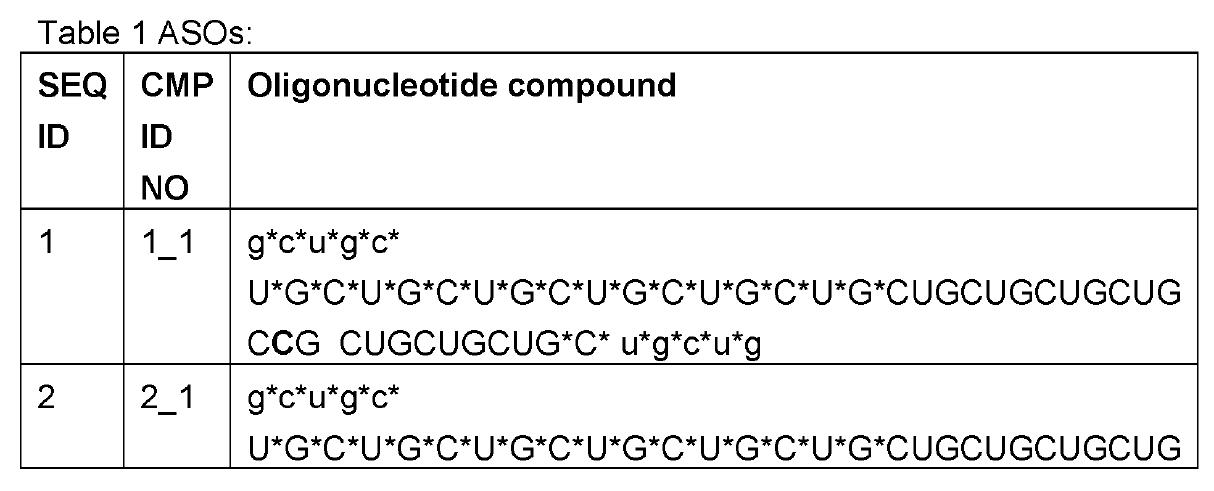
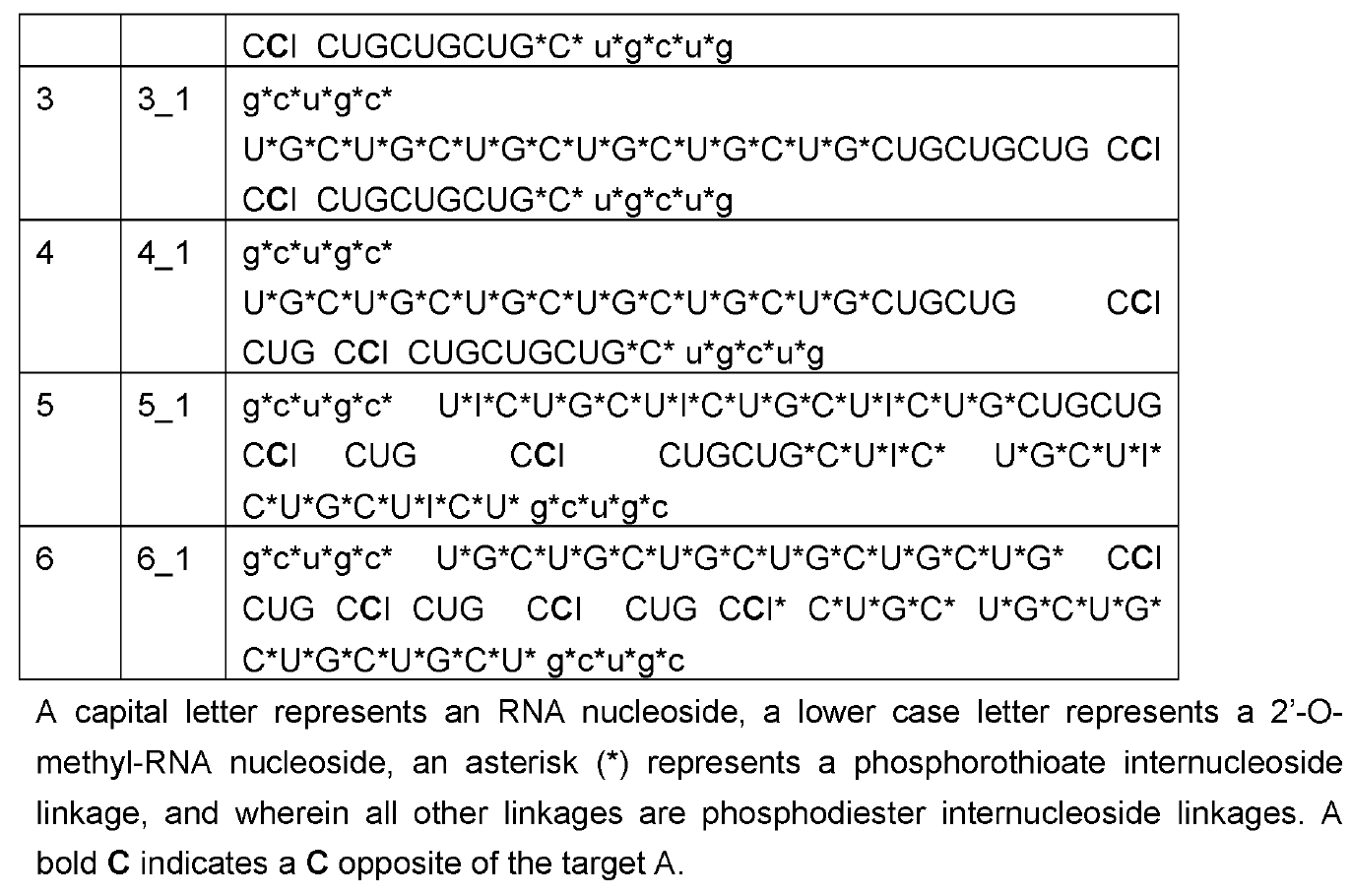
Employing ~50-60nt long CUG repeats (the complement of CAG), their editing oligonucleotides were above the typical length of ~30nt as now generally practiced by the leading RNA Editing companies ProQR and Wave Life Sciences.  These were transfected into HeLa cells expressing ATXN3 mRNA with 21-22 repeat CAGs all in the apparent absence of ADAR overexpression.  

The oligonucleotides were modified with 2’-o-methyl only in the 5 nucleotides on the 5’ and 3’ ends each; phosphorothioation of the backbone was also practiced at the wings of the oligos, but extended further into the center than the 2'-o-methyls.  The central part consisted of pure RNA. 


An orphan C was placed towards the 3’ end of the targeting oligo.  This creates a mismatch to the target A as is commonly practiced in the field.  Interestingly, an inosine follows 3’ of the orphan C and this is also practiced by some other companies as e.g. evidenced in last year’s high-profile paper on long-lived and potent ADAR editing in non-human primates by Wave Life Sciences in Nature Biotech.

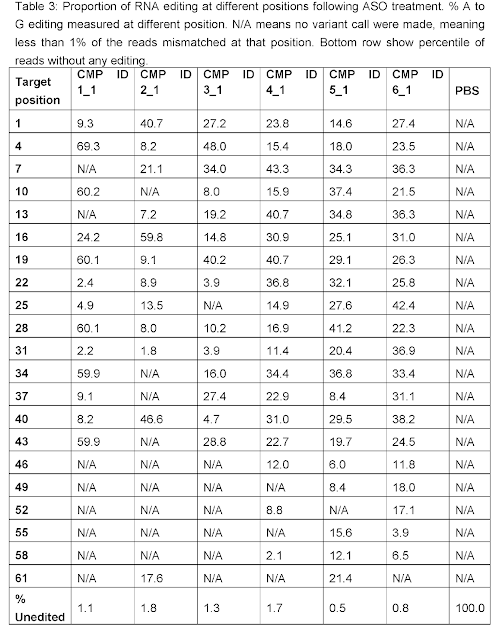
Remarkably, robust 20-50% AàI conversions were seen for many As in the ATXN3 CAG repeat with more pronounced editing towards the 5’ end of the repeat region consistent with the 3’ placement of the orphan C in the targeting oligonucleotide.  Moreover, less than 2% of the ATXN3 mRNAs was unmodified for each editing oligo.  If you consider that a huntingtin allele with say 33 CAG repeats does not result in Huntington’s disease, but one with 37 repeats typically does, you can imagine the impact that just a single or two successful editing events should have on pathogenicity of the resulting protein.


This experiment thus is an important de-risking step for RNA Editing in repeat expansion diseases and should whet the appetite of Roche which is already heavily invested in oligonucleotide therapeutics for Huntington’s through its collaboration with Ionis Pharmaceuticals (RNaseH mechanism), including research on improving the convenience and efficacy of intrathecal oligo administration.

As an investor in ProQR I was, of course, pleased to see that when discussing the prior art of ADAR editing in general, all 5 patent applications cited by Roche referred to ones controlled by ProQR. 

Looking forward to the next chapter in this story.

Saturday, March 3, 2018

Antisense Technology Produces Huntington’s Disease Breakthrough

Huntington’s Disease (HD) is one of the most prevalent severe, ultimately fatal genetic neurological diseases of our times for which impactful treatments are desperately lacking.  Based on results from a clinical study aiming to knockdown the disease-causing gene using RNaseH antisense technology, this is about to change over the next 3 years.

IONIS-HTTRx study results presented at CHDI

At the major annual HD gathering this week, lead investigator Tabrizi from the University College London presented data from a phase I-II study of antisense drug candidate IONIS-HTTRx in patients with early symptoms of the disease.

IONIS-HTTRx (aka RG6042), developed by Ionis and partnered with Roche, targets both wild-type and mutant huntingtin protein to provide all patients with the most potent and safest sequence possible.  While mutant allele-specific approaches have been discussed and are being pursued by antisense rival Wave Life Sciences, the concern that suppressing wildtype huntingtin in adults seems to me a far-fetched theoretical discussion, if not wishful thinking given that antisense is unlikely to completely eliminate wildtype huntingtin and that the drug is being given to adults.  

To wit, the concern is based on genetic mouse models where complete huntingtin knockout causes embryonic lethality. Importantly, this is not recapitulated in mouse model where knockout is delayed until adulthood.

Call me cynical, but the choice of an allele-specific approach by Wave Life Sciences has likely been primarily motivated by allowing for some follower differentiation.  Ironically, by limiting themselves to a much reduced sequence space around co-segregating single nucleotide polymorphisms, the sequences may not only lack the potency, but also the apparent safety of IONS-HTTRx.

Good safety profile maintained until highest dose tested

In this study, IONIS-HTTRx was given monthly over 3 months.  Speaking to the safety of the approach, apart from transient side effects due to the intrathecal mode of administration, no adverse events of note were reported and all 46 subjects have subsequently rolled over into the open-label extension study.

Importantly, doses as high as 120mg monthly were well tolerated at which dose the knockdown effect seems to have plateaued.  This not only bodes well for IONIS-HTTRx, but for the entire neurological disease franchise of Ionis Pharmaceuticals. 

The human safety and tolerability results are consistent with a range of small and large animal models (including dogs, pigs, non-human primates), some of which were a year or longer in duration.

Robust huntingtin lowering

It is widely thought that mutant huntingtin protein is harmful to the cell expressing it, ultimately resulting in neuronal death throughout the brain.  This can be visualized by considerable, 30%-level atrophy of the brain over the course of the disease.

Although it is not possible to assess huntingtin levels directly in brain tissue in humans from biopsies, the experience in the preclinical animal models and human data from spinal muscular atrophy drug SPINRAZA allows one to model the correlation between ASO-dependent protein changes in the cerebrospinal fluid (CSF) and the various areas of the CNS quite well.

Since SPINRAZA is based on chemistry that is highly similar to that of IONIS-HTTRx, they behave identically in terms of biodistribution for all intents and purposes.

In the two highest cohorts, 90mg and 120mg, mean 40% mutant huntingtin reductions in the CSF were observed shortly after the last dose with further reductions (50%+) seen thereafter.  Such levels are predicted to reflect 55 to up to 85% reductions in the cortex and 20-50% in the caudate.

This degree of knockdown exceeds that necessary to see changes in HD animal models, some of which with manifest disease symptoms at treatment onset.


The future is bright

The study results therefore raise hopes that  IONIS-HTTRx may halt or even reverse disease in manifest HD patients.  As exciting and medically likely with the biggest bang for the buck is the prospect that the drug candidate may prevent disease symptoms to emerge in the first place when given early to those at risk of developing the disease (~1 in 2 with a parent having HD, 200,000 in the US alone). 

The companies and clinical investigators are now busy designing a pivotal outcomes study which I would guess will ultimately involve 150-250 early-stage patients over a period of 16-24 months.  The size and extent of the trial will depend on which endpoints are chosen.  A pre-planned interim look at ~12 months may also make sense to look at brain size as a potential way to obtain accelerated approval.  Accelerated approval under the new FDA may also be possible based on functional analyses the investigators are currently conducting using data from the present study and the open-label extension with dosing well beyond 3 months..

In drug development, sometimes you can tell early on whether a drug candidate is destined to breeze through to approval. In this regard, IONIS-HTTRx certainly feels like Spinraza.

Monday, December 11, 2017

Gene Knockdown in Disease Involving Gene Expression Throughout Brain Reported

Today, Ionis issued a press release revelaing that their drug candidate for Huntington’s Disease was able to knock down the huntingtin target gene in a dose-dependent manner.  This is the first clinical demonstration that single-stranded phosphorothioate antisense technology cannot only engage gene targets, as had been shown in the gain-of-function approach for spinal muscular atrophy (SPINRAZA; slide 58), but that it could do so in a sufficiently robust manner so that a knockdown could be measured.

This, of course, has broad implications for the Ionis antisense platform which is similarly being developed for other RNaseH-based knockdown applications ranging from the rare and severe (e.g. ALS, spinal cerebellar ataxias) to the more common neurodegenerative diseases such as Alzheimer’s and Parkinson’s.

The reason why this feat is remarkable and a great de-risking event for the technology is that in some of the indications, the target gene is expressed and needs to be suppressed more or less throughout the brain.  Assuming Ionis didn’t take brain biopsies, but instead looked for protein expression by taking CSF samples which would +/- give you an average of target gene expression in the entire CNS (a safe assumption), the ability to assess a dose-dependent gene knockdown is a testament to the robustness of the gene knockdown.

The actual numbers, however, remain under wraps as Ionis and partner Roche (which has exercised its option to IONS-HTTRx in the wake of the data) plan to present them more formally through a publication and a conference presentation with key thought leaders in the disease present.  My guess is that peak knockdown is in the 50%+ range which Frank Bennett from Ionis has recently referred to be in the desired knockdown range.


Given that dosing in the study only lasted 3 months in this slowly progressive disease, it is unlikely that actual clinical benefits will be reported from this phase I/IIa study.  But given the so called 'huntingtin knockdown holiday phenomenon' and some remarkable comments from investigators in the study and KOLs, one cannot but hope that we’ll be in for a positive surprise.  

Saturday, February 23, 2008

Recent Alnylam Patents Blur Distinction between Blunt-end dsRNAs and those with 3’ Overhangs

As many of you will be aware, the battle for RNAi IP is heated and particularly centers on whether Alnylam may also dominate over blunt-ended double-stranded RNAs between 22 and 24 base-pairs in length. Longer dsRNAs are covered by Fire and Mello and relatively easily accessible, 21bp and shorter dsRNAs are the domain of Kreutzer-Limmer and exclusive to Alnylam as are dsRNAs up to 25bp with 3’ overhangs (Tuschl II).

Although, even in the absence of applying obviousness criteria, I doubt that if Kreutzer-Limmer ultimately failed to be applied to 22-24bp RNAs, any other patent application would be able to do so based on prior art, this still raises the question whether 22-24bp RNAs will fall into a free-for-all grey zone.

While the seminal Elbashir et al. publication underlying Tuschl II provided compelling evidence that in most cases 3’ overhangs will enhance RNAi gene silencing, at least in tissue culture, recent patent application by Alnylam itself make me rethink the value of blunt-ends, particularly for in vivo applications.

At the end of January, Alnylam issued a press release on the issuance of the Woppmann patents in the UK (UK 2417727). Although I would not, by any stretch of the imagination, consider it to be an umbrella patent of the stature of Tuschl II, it is still a quite curious patent with relatively early 2003-4 priority in that it describes siRNAs with one blunt-end and one 3’ overhang end (often just one nucleotide) to have gene silencing advantages over the classical Tuschl design features (two 3’ overhangs, best if 2 nucleotides long).

I know that the following passage from the PR has caused some confusion among some of the readers of this blog, and admittedly also myself, as without carefully reading the claims of the patent it could be misunderstood as also covering dsRNAs with two blunt-ends, instead of dsRNAs combining the two features in just one molecule: ”The claims cover siRNA molecules of any length that contain "overhang" and "blunt end" design features, including siRNAs containing chemical modifications and certain novel motifs.”

Does this mean that Alnylam is back-tracking here on the value of 3’ overhangs, i.e. Tuschl II, which could have serious repercussions for the whole RNAi Therapeutics IP space and give companies like Silence Therapeutics or RXi some room to breath? The issue therefore is whether the one 1-nucleotide overhang is really that advantageous or just serves as a fig-leaf designed to disguise the value of blunt-end siRNAs. I therefore found the following passage from the description of another recent Alnylam patent application on the targeting of the Huntingtin gene by RNAi (USPTO application no. 11/588,674) of interest:

“In one embodiment, at least one end of the dsRNA has a single-stranded nucleotide overhang of 1 to 4, preferably 1 or 2 nucleotides. dsRNAs having at least one nucleotide overhang have unexpectedly superior inhibitory properties than their blunt-ended counterparts. Moreover, the present inventors have discovered that the presence of only one nucleotide overhang strengthens the interference activity of the dsRNA… dsRNA having only one overhang has proven particularly stable and effective in vivo, as well as in a variety of cells, cell culture mediums, blood, and serum.”

Maybe it should not come as a surprise that with intense research, the design features of RNAi triggers will evolve over time, somewhat reminiscent of what had happened with monoclonal antibodies before and this can only be a blessing for the realization of RNAi Therapeutics. However, from a business point of view, this raises the question what will be considered sufficiently novel or merely an improvement of a fundamental design. Clearly, at a time when many dsRNAs and also single-stranded oligonucleotides are found to be able to accomplish gene silencing via RNAi, the systematic analysis of particularly dsRNAs between ~19-25bp in length with various types of overhangs or no overhangs should be of value here. I’m almost sure this has been done already and is ongoing in other parts of the industry, but it certainly would be nice to see an unbiased publication on that very subject.
By Dirk Haussecker. All rights reserved.

Disclaimer: This blog is not intended for distribution to or use by any person or entity who is a citizen or resident of, or located in any locality, state, country or other jurisdiction where such distribution, publication, availability or use would be contrary to law or regulation or which would subject the author or any of his collaborators and contributors to any registration or licensing requirement within such jurisdiction. This blog expresses only my opinions, they may be flawed and are for entertainment purposes only. Opinions expressed are a direct result of information which may or may not be accurate, and I do not assume any responsibility for material errors or to provide updates should circumstances change. Opinions expressed in this blog may have been disseminated before to others. This blog should not be taken as investment, legal or tax advice. The investments referred to herein may not be suitable for you. Investments particularly in the field of RNAi Therapeutics and biotechnology carry a high risk of total loss. You, the reader must make your own investment decisions in consultation with your professional advisors in light of your specific circumstances. I reserve the right to buy, sell, or short any security including those that may or may not be discussed on my blog.