Pages

Showing posts with label NTLA-2002. Show all posts

Sunday, June 15, 2025

NTLA-2002 More and More Looks Like a Cure for HAE

When Intellia Therapeutics set out to develop a CRISPR-based prekallikrein knockout for hereditary angioedema (HAE), it was as a compelling alternative to the newer prophylactic treatments. Cas9 nucleause-based NTLA-2002 (aka lonvo-z) was aimed at having similar efficacy and safety/tolerability, but with the added significant benefits of liberating patients from repeated injections, from having to worry about continued drug reimbursement, all while saving the healthcare system money and resources.

All this is changing as the company is presenting longer-term data strongly suggesting that NTLA-2002 could be a life-time functional cure for many, if not most people living with HAE.

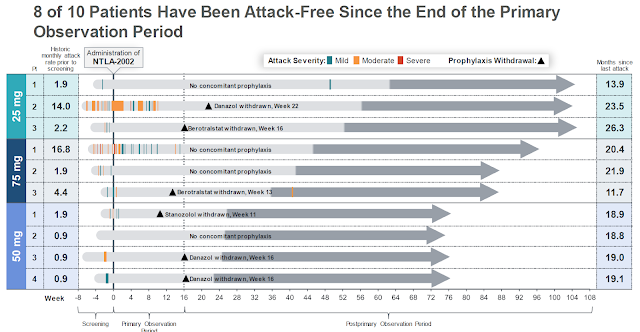
Today, at the EAACI Annual Meeting, Intellia showed that there have been no more HAE attacks since the last update a year ago.  All 10 subjects in this now open-label extension trial have now been attack-free for at least 15 months with a median of almost 2 years.  These 10 patients would have conservatively had around 500 attacks based on their disease history.


500 versus zero, nothing short of a revolution in the management of HAE.  Importantly, with 9 of the 10 subjects having reached 20-30 months after dosing, no drug-related adverse event has been documented after day 28 following NTLA-2002 infusion.

As the data gets better over time, it looks like tonic PKK reduction below a certain threshold may normalize the bradykinin system und put a brake on a neurogenic attack feedback loop.  We know that attacks are frequently triggered by mental and hormonal stress.  In turn, attacks can increase anxiety.  It now looks similar to chronic itch that once the feedback loop is interrupted (HAE attack and scratching) there is a real chance of sustained outcomes.  That this is possible is also illustrated by the fact that people with C1 Inhibitor mutations (the causal mutation in HAE) often do not have any attacks before puberty.

Today’s development illustrates that CRISPR genome editing going after the same targets as competitive modalities can lead to superior outcomes and actually free people from disease instead of keeping them dependent on medicines.  Needless to say, patients are queuing up for the treatment and the pivotal phase 3 trial has been fully enrolled- well ahead of schedule.

Tuesday, May 27, 2025

First Commercializations of Systemic Therapies as Backstop for CRISPR Investors

There is widespread consternation about the disconnect between recent clinical breakthroughs and the performance of CRISPR-related stocks.  I am highly confident that this will correct by mid-2027 at the latest when NTLA-2002 should become the first systemically administered CRISPR therapeutic to be commercialized.  It will demonstrate the high demand by patients and physicians for this revolution in medicine and commercial viability.


KOL enthusiasm

In 2017 at the iconic Paris ATTR Amyloidosis Meeting where Alnylam unveiled the biggest clinical breakthrough in RNAi, the eyes of key opinion leader Dr Julian Gillmore (UCL) lit up when going another step forward into the future, talking about the promise of one-dose CRISPR genome editing for the disease.  This was notable since he is essentially involved in all the key clinical programs in ATTR amyloidosis irrespective of modality, including TTR stabilizers and RNAi silencing.    

I noticed similar genuine enthusiasm at last year’s ACAAI meeting from hereditary angioedema (HAE) KOL Dr Banerji (Harvard) regarding NTLA-2002 after experiencing NTLA-2002 in her own patients.  Another seeing-is-believing moment was recently voiced by Prof Patel of UCL, an investigator in the VERVE-102 PCSK9 base editing trial:

 “This is reality; it’s not science fiction. We’re actually doing it. I’ve had patients of mine in the trial receive this one-and-done treatment, and it’s going to change the face of cholesterol management going forward.”

I have yet to see a single trial investigator or KOL who has deeply thought about the implications of one-time therapies in clinical development for the above diseases and discarded them as freakish or irresponsible as people invested in competing therapies like to do.


Patient enthusiasm

The same holds true for patients, that is the people whose voice should have the most weight in the discussion on the risk/benefits and ethics of genome editing. 

In a patient preference survey commissioned by Verve Therapeutics, one third already stated that a one-time genome editing treatment would be more appealing to them than daily pills or injectible drugs.  I expect this number to further increase as VERVE-102 makes its way through the clinic and first patients get treated commercially (word of mouth will be tremendous). 


Similarly, HAE patients confronted with NTLA-2002 look to it with hopes of allowing them to forget about their disease and not having to worry about getting repeat-administered drugs covered by insurance in perpetuity.  Accordingly, enrolment in the phase 3 HAELO trial is extraordinarily swift as patients are lining up for NTLA-2002 according to Intellia Therapeutics.


But what about payors?

Besides public acceptance of CRISPR genome editing, cost for these one-time therapies is often brought up as an argument against CRISPR.  Surely, they will be prohibitively expensive.  Why for example would anybody pay $2M for ATTR-drug NTLA-2001 when you can get the RNAi alternative for just $500k annually.  Sure, some people will rent the child booster from the rental car company at $20 a day, instead of buying one from a Walmart around the corner for the same price.

If anything, it is CRISPR Therapeutics that have the pricing power in most settings, including for mass markets like cholesterol lowering (--> VERVE-102).  The vastly superior outcomes in terms of morbidity and mortality projected for life-long LDL cholesterol lowering, especially when initiated early on, should more than compensate the $100k or so price tag I expect it to carry initially.  There is also a noticeable shift in the new US administration towards preventing rather than treating disease.  No better modality than genome editing for that as long as the delivery and gene target is safe.

In the words of Stanford’s genome editing scientist Matt Porteus at the 2025 Copenhagen CRISPR conference, the US insurance system is 'f*cked up', but with many eyes nowadays on how the insurance and PBM industry deals with access (see United Health) and the aforementioned inherent pricing power of (non-viral) genome editing, payors will not meaningfully stand in the way of these therapies.  Similarly, the new modality should run into open doors with Medicare and Medicaid who are most vested in the long-term outcomes of covered lives.


Momentum building

With NTLA-2002 likely wrapping up enrolment in Q3, we should see the first commercialization of the promising crop of systemically administered CRISPR drugs in mid-2027.  NTLA-2001 for ATTR-PN, BEAM-302 for AATD, VERVE-102 for heFH and high-risk ASCVD, and finally NTLA-2001 for ATTR-CM should follow in 2028/9.  When the sales numbers finally come in, even the longest naysaying hold-outs will have to admit defeat and CRISPR stocks should rebound.  This could be greatly catalyzed if that happens in a lower interest rate environment (Powell will be replaced in 2026).


But even before that, the steady stream of recent clinical successes (VERVE-102, urea cycle N=1 base editing, NTLA-2001 ATTR-PN data at PNS, BEAM-302 initial data) have led to increased broader interest in CRISPR with large social and traditional media accounts talking about the technology once again.  If industry validation is what you are looking for, with Regeneron and Eli Lilly having to make their respective NTLA-2001 and VERVE-102 opt-in decisions soon and share prices dangerously low, we could see ‘strategics’ stepping in.  The dam could break any day, in a positive way, for long-suffering investors.

Wednesday, October 9, 2024

Genome Editing for Hereditary Angioedema Promises a Life Free from Disease Burden

Intellia Therapeutics is about to unveil phase II data on NTLA-2002 at the end of the month.  NTLA-2002 aims to be a one-time treatment for hereditary angioedema (HAE). Prior phase I data looked intriguing with all 10 subjects becoming essentially attack free in the months following (1-time) drug administration and safety findings limited to around the time of treatment.

Still, the study involved too few patients for too short time to clearly define the commercial product in terms of dose, safety, and efficacy (including durability).


HAE is a rare disease with an estimated incidence of 1:10000 to 1:50000 depending on geography. These angioedema attacks are characterized by tissue swelling due to the influx of liquid into tissues through leaky vasculature as a result of bradykinin generation.  With few exceptions, they occur in people due to their genetic lack of C1 esterase inhibitor function.   HAE must be differentiated from allergic edema and as such is not responsive to antihistamines or corticosteroids.

In addition to outwardly visible soft tissue swelling, e.g. of the lips and hands, it can also involve internal systems like the abdomen and lead to excruciating pain.  Suffocation from laryngeal edema is probably the most feared disease manifestation.  It is therefore not surprising that many patients become depressed, stop engaging in normal daily activities to avoid anything that may set off attacks, including stressful situations, physical activity and injury (including surgery). 

Rapid progress in the understanding of the biology behind HAE has resulted in a number of treatments for on-demand and prophylactic uses and significantly improved the outlook for patients.  Still, there is widespread dissatisfaction with the incomplete protection and requirement for regular drug administration of current prophylactic treatments while the utility, convenience, side effects and even embarrassment that come from taking on-demand drugs is being questioned.

Switching between drugs and treatment approach is common and with costs often on the order of $500,000 per annum, access can be a real issue causing additional anxiety.


Enter NTLA-2002

NTLA-2002 promises to address all these challenges. 

That’s a bold statement, but the phase I clinical data provide hints that this could become reality, commercially in 2027 if you are living in the US or even earlier if you decided to and qualified for the global pivotal clinical trial that has just commenced.

NTLA-2002 is a CRISPR-based genome editing treatment that permanently and selectively disrupts the KLB1 gene in liver hepatocytes.  KLB1 codes for plasma prekallikrein (PKK) which is a critical component in the kallikrein-kinin inflammatory system.  Importantly, there are people that naturally lack plasma PKK (Fletcher’s syndrome) or another key component, Factor XII, and these appear to be perfectly healthy.  They are typically only identified by coincidence following routine lab tube tests showing prolonged activated partial thromboplastin time without an actual negative impact on bleeding or otherwise in the natural context.  Deleting KLB1 in the liver should therefore be safe. 

NTLA-2002 comprises of a messenger and guide RNAs entrapped in liposomal nanoparticles (LNPs) similar to the covid mRNA vaccines. Following one-time intravenous administration, these traffic to the liver hepatocytes where the guide RNA directs the CRISPR Cas9 enzyme to disrupt the KLB1 gene. 

Such a formulation already exists commercially in the form of ONPATTRO.  ONPATTRO is an RNAi therapy that is administered every 3 weeks.  Similar to the phase 1 study of NTLA-2002 (Longhurst et al 2024), transient immune suppression (corticosteroids, antihistamines) is practiced around the i.v. administration.  The great thing about NTLA-2002 is that the side effects from this procedure are well recognized and managed and would only present once- if at all.

As mentioned above, all10 subjects in the dose-ranging phase I study of NTLA-2002 have essentially become attack free once the medicine had a chance to do its work, destroy hepatocyte KLB1 and normalize the kallikrein-kinin-system.  This indicates that after the optimal dose has been found, a good number of HAE patients may go on with life and forget about their disease!  So patients may not only enjoy the best efficacy of any HAE treatment, they would only have to take it once.


The phase II study results will more than triple the number of patients that have been (hopefully successfully) exposed to NTLA-2002 and thus provide a good basis for the dose chosen to undergo confirmatory phase 3 testing.  Based on recent statements, the company will select the 50mg dose which in the phase I study gave -88% plasma PKK reduction, a level well above the -45% reduction where HAE attack rates start to drop off precipitously (Riedel et al 2024).   

For those that continue to experience a rare attack, it may be possible to give another dose of NTLA-2002.  Data from another (monthly administered) antisense oligonucleotide therapeutic (donidalorsen) targeting the same PKK gene indicate that attack rate reduction and PKK inhibition are tightly correlated (Riedel et al 2024).  It is therefore conceivable that once plasma PKK drops below a critical concentration in the blood, swelling attacks are virtually eliminated.  A presentation at the upcoming ACAAI meeting by the sponsor of donidalorsen, Ionis Pharmaceuticals, should further shed light on this.    

Medical innovation is costly and NTLA-2002 which promises to be the second approved CRISPR genome editing therapeutic following Casgevy for sickle cell disease will be no different.  Given the rarity of HAE, it would not be surprising if it cost 2 to 3 million USD for treating a patient.  This compares to other medications in the space, including Cinryze or Takzhyro, which often carry annual price tags exceeding $500,000.  Sure, healthcare administrators are likely to throw up their hands and have sticker shock, but simple math shows a one-time treatment to be a real money saver for patients that have decades of disease-free lives in front of them. 

Disclosure: this is not medical advice. Always talk to your HAE specialist doctor first before making a treatment decision.

Monday, November 14, 2022

Ionis Widens Its Modality Horizons

Over the weekend, blue chip antisense oligonucleotide company Ionis and genome editing competitor Intellia presented data on targeting prekallikrein (PKK) for treating hereditary hemeangioedema (Ionis donidalorsen here, Intellia NTLA-2002 here).

Using CRISPR Cas9 endonucleolytic disruption of the KLKB1 gene coding for PKK following LNP delivery, Intellia came out as the apparent winner in this showdown.  Not only did they demonstrate more pronounced PKK inhibition, but also more consistent elimination of debilitating attacks characteristic of the disease.  Moreover, by exploring less frequent antisense oligonucleotide administrations despite suboptimal low -60% knockdown, Ionis indicates that it is worried about the safety and tolerability profile of donidalorsen. 

Whether reversible approaches like antisense and RNAi or irreversible approaches like CRISPR gene disruption will ultimately prevail in the HAE race remains to be seen and will likely be decided by the safety of suppressing PKK expression over the long-term. If there is an overshoot of CRISPR-mediated gene disruption that would e.g. result in blood clotting abnormalities, even for a subset of patients, the field would be wide open for reversible methods.  

Ionis invests in genome editing

But whether that will be antisense remains to be seen.  Especially for targets in the liver, RNAi currently clearly rules the land for gene knockdown: highly potent, titratable and reversible knockdown with 5 years counting without a notable setback, especially related to off-target toxicity.  By contrast, Ionis is being held back by persistent safety issues as it has been beating a dead horse with its phosphorothioate-based backbone chemistry although it appears to be finally weaning itself off with chemistries such as the Mspa backbone.

So it is probably the hope of leap-frogging the RNAi competition by adopting genome editing as Ionis today announced that it was partnering with CRISPR genome editing company Metagenomi.  The HAE data comparison could not have come at a more opportune time.  

One declared aim of the investment in genome editing is life-cycle management of existing franchises.  In the liver, these franchises (TTR amyloidosis, ApoC3, PCSK9 etc) are currently and in the foreseeable future being dominated by RNAi despite Ionis’ heavy investments, so it clearly makes sense to amortize its investments in disease-specific market research, commercial infrastructure and clinical trial experience to accelerate the success of a more promising approach. 

TTR amyloidosis is a great example where even GalNAc-conjugated follow-on antisense compounds are unlikely to challenge Alnylam’s suite of RNAi triggers.  Also due to this dominance, it makes less sense for Ionis to develop an RNAi competitor drug despite its access and now actual adoption of this modality for targets in the muscle.  But as TTR shows, other genome editing companies are already competing for some of these targets so it won’t be all that simple trying to leap-frog RNAi and Alnylam like that.


The rise of the multi-modality oligonucleotide therapeutics companies

After straight-forward antisense for gene knockdown and then splice modulation, with the recent adoption of RNAi and genome editing, Ionis is rapidly expanding its oligonucleotide modality toolbox.

In fact, it is becoming a little bit like smaller competitor Wave Life Sciences which has been practicing all types of antisense (knockdown, splice modulation, more recently RNA editing) and RNAi using a bewildering mix of chemistries.  Not only are they burning through cash as if there was no recession and inflation problem, I never liked that because clinical failure after failure (esp. minute target engagements at best) suggest that the company is stretching itself too thin.

By comparison, Ionis, with $2 billion in cash and a more experienced and bigger operation is a different beast altogether and may be able to pull it off, at least on a technical level.  However, instead of spending $80M in upfront alone on a modality that is somewhat further removed from its traditional chemistries (longer mRNAs, LNP delivery for CRISPR), it could have much more synergistically leveraged its investments in chemistry and delivery by investing that same amount in the ripe-for-the-picking RNA editing.  Accordingly, $80M is more than the market cap of my currently favourite RNA editing investment, ProQR.

I’m sure the opportunity to expand druggable targets and indications by applying existing delivery technologies and chemistry know-how by adopting RNA editing is not lost on RNAi players such as Alnylam and especially Arrowhead Pharmaceuticals.  Arrowhead in particular, having scooped up the RNAi assets of Novartis and Roche for peanuts has demonstrated an ability to recognize and act on similar opportunities.

By Dirk Haussecker. All rights reserved.

Disclaimer: This blog is not intended for distribution to or use by any person or entity who is a citizen or resident of, or located in any locality, state, country or other jurisdiction where such distribution, publication, availability or use would be contrary to law or regulation or which would subject the author or any of his collaborators and contributors to any registration or licensing requirement within such jurisdiction. This blog expresses only my opinions, they may be flawed and are for entertainment purposes only. Opinions expressed are a direct result of information which may or may not be accurate, and I do not assume any responsibility for material errors or to provide updates should circumstances change. Opinions expressed in this blog may have been disseminated before to others. This blog should not be taken as investment, legal or tax advice. The investments referred to herein may not be suitable for you. Investments particularly in the field of RNAi Therapeutics and biotechnology carry a high risk of total loss. You, the reader must make your own investment decisions in consultation with your professional advisors in light of your specific circumstances. I reserve the right to buy, sell, or short any security including those that may or may not be discussed on my blog.