Pages

Showing posts with label hereditary angioedema. Show all posts

Sunday, June 15, 2025

NTLA-2002 More and More Looks Like a Cure for HAE

When Intellia Therapeutics set out to develop a CRISPR-based prekallikrein knockout for hereditary angioedema (HAE), it was as a compelling alternative to the newer prophylactic treatments. Cas9 nucleause-based NTLA-2002 (aka lonvo-z) was aimed at having similar efficacy and safety/tolerability, but with the added significant benefits of liberating patients from repeated injections, from having to worry about continued drug reimbursement, all while saving the healthcare system money and resources.

All this is changing as the company is presenting longer-term data strongly suggesting that NTLA-2002 could be a life-time functional cure for many, if not most people living with HAE.

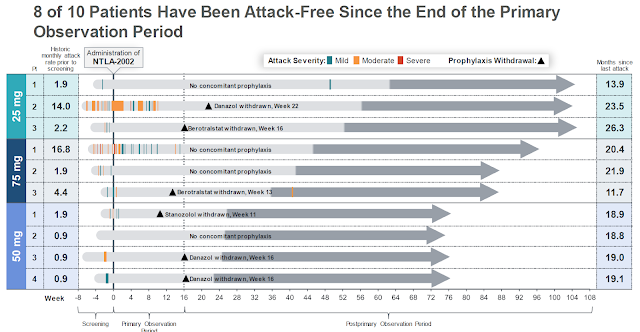
Today, at the EAACI Annual Meeting, Intellia showed that there have been no more HAE attacks since the last update a year ago.  All 10 subjects in this now open-label extension trial have now been attack-free for at least 15 months with a median of almost 2 years.  These 10 patients would have conservatively had around 500 attacks based on their disease history.


500 versus zero, nothing short of a revolution in the management of HAE.  Importantly, with 9 of the 10 subjects having reached 20-30 months after dosing, no drug-related adverse event has been documented after day 28 following NTLA-2002 infusion.

As the data gets better over time, it looks like tonic PKK reduction below a certain threshold may normalize the bradykinin system und put a brake on a neurogenic attack feedback loop.  We know that attacks are frequently triggered by mental and hormonal stress.  In turn, attacks can increase anxiety.  It now looks similar to chronic itch that once the feedback loop is interrupted (HAE attack and scratching) there is a real chance of sustained outcomes.  That this is possible is also illustrated by the fact that people with C1 Inhibitor mutations (the causal mutation in HAE) often do not have any attacks before puberty.

Today’s development illustrates that CRISPR genome editing going after the same targets as competitive modalities can lead to superior outcomes and actually free people from disease instead of keeping them dependent on medicines.  Needless to say, patients are queuing up for the treatment and the pivotal phase 3 trial has been fully enrolled- well ahead of schedule.

Wednesday, October 9, 2024

Genome Editing for Hereditary Angioedema Promises a Life Free from Disease Burden

Intellia Therapeutics is about to unveil phase II data on NTLA-2002 at the end of the month.  NTLA-2002 aims to be a one-time treatment for hereditary angioedema (HAE). Prior phase I data looked intriguing with all 10 subjects becoming essentially attack free in the months following (1-time) drug administration and safety findings limited to around the time of treatment.

Still, the study involved too few patients for too short time to clearly define the commercial product in terms of dose, safety, and efficacy (including durability).


HAE is a rare disease with an estimated incidence of 1:10000 to 1:50000 depending on geography. These angioedema attacks are characterized by tissue swelling due to the influx of liquid into tissues through leaky vasculature as a result of bradykinin generation.  With few exceptions, they occur in people due to their genetic lack of C1 esterase inhibitor function.   HAE must be differentiated from allergic edema and as such is not responsive to antihistamines or corticosteroids.

In addition to outwardly visible soft tissue swelling, e.g. of the lips and hands, it can also involve internal systems like the abdomen and lead to excruciating pain.  Suffocation from laryngeal edema is probably the most feared disease manifestation.  It is therefore not surprising that many patients become depressed, stop engaging in normal daily activities to avoid anything that may set off attacks, including stressful situations, physical activity and injury (including surgery). 

Rapid progress in the understanding of the biology behind HAE has resulted in a number of treatments for on-demand and prophylactic uses and significantly improved the outlook for patients.  Still, there is widespread dissatisfaction with the incomplete protection and requirement for regular drug administration of current prophylactic treatments while the utility, convenience, side effects and even embarrassment that come from taking on-demand drugs is being questioned.

Switching between drugs and treatment approach is common and with costs often on the order of $500,000 per annum, access can be a real issue causing additional anxiety.


Enter NTLA-2002

NTLA-2002 promises to address all these challenges. 

That’s a bold statement, but the phase I clinical data provide hints that this could become reality, commercially in 2027 if you are living in the US or even earlier if you decided to and qualified for the global pivotal clinical trial that has just commenced.

NTLA-2002 is a CRISPR-based genome editing treatment that permanently and selectively disrupts the KLB1 gene in liver hepatocytes.  KLB1 codes for plasma prekallikrein (PKK) which is a critical component in the kallikrein-kinin inflammatory system.  Importantly, there are people that naturally lack plasma PKK (Fletcher’s syndrome) or another key component, Factor XII, and these appear to be perfectly healthy.  They are typically only identified by coincidence following routine lab tube tests showing prolonged activated partial thromboplastin time without an actual negative impact on bleeding or otherwise in the natural context.  Deleting KLB1 in the liver should therefore be safe. 

NTLA-2002 comprises of a messenger and guide RNAs entrapped in liposomal nanoparticles (LNPs) similar to the covid mRNA vaccines. Following one-time intravenous administration, these traffic to the liver hepatocytes where the guide RNA directs the CRISPR Cas9 enzyme to disrupt the KLB1 gene. 

Such a formulation already exists commercially in the form of ONPATTRO.  ONPATTRO is an RNAi therapy that is administered every 3 weeks.  Similar to the phase 1 study of NTLA-2002 (Longhurst et al 2024), transient immune suppression (corticosteroids, antihistamines) is practiced around the i.v. administration.  The great thing about NTLA-2002 is that the side effects from this procedure are well recognized and managed and would only present once- if at all.

As mentioned above, all10 subjects in the dose-ranging phase I study of NTLA-2002 have essentially become attack free once the medicine had a chance to do its work, destroy hepatocyte KLB1 and normalize the kallikrein-kinin-system.  This indicates that after the optimal dose has been found, a good number of HAE patients may go on with life and forget about their disease!  So patients may not only enjoy the best efficacy of any HAE treatment, they would only have to take it once.


The phase II study results will more than triple the number of patients that have been (hopefully successfully) exposed to NTLA-2002 and thus provide a good basis for the dose chosen to undergo confirmatory phase 3 testing.  Based on recent statements, the company will select the 50mg dose which in the phase I study gave -88% plasma PKK reduction, a level well above the -45% reduction where HAE attack rates start to drop off precipitously (Riedel et al 2024).   

For those that continue to experience a rare attack, it may be possible to give another dose of NTLA-2002.  Data from another (monthly administered) antisense oligonucleotide therapeutic (donidalorsen) targeting the same PKK gene indicate that attack rate reduction and PKK inhibition are tightly correlated (Riedel et al 2024).  It is therefore conceivable that once plasma PKK drops below a critical concentration in the blood, swelling attacks are virtually eliminated.  A presentation at the upcoming ACAAI meeting by the sponsor of donidalorsen, Ionis Pharmaceuticals, should further shed light on this.    

Medical innovation is costly and NTLA-2002 which promises to be the second approved CRISPR genome editing therapeutic following Casgevy for sickle cell disease will be no different.  Given the rarity of HAE, it would not be surprising if it cost 2 to 3 million USD for treating a patient.  This compares to other medications in the space, including Cinryze or Takzhyro, which often carry annual price tags exceeding $500,000.  Sure, healthcare administrators are likely to throw up their hands and have sticker shock, but simple math shows a one-time treatment to be a real money saver for patients that have decades of disease-free lives in front of them. 

Disclosure: this is not medical advice. Always talk to your HAE specialist doctor first before making a treatment decision.

Friday, April 3, 2015

Hereditary Angioedema: A High-Value RNA Therapeutics Target Confirmed by Antibody Trial

This week, Dyax released early, but arguably impressive data from a phase Ib trial of monoclonal antibody DX-2930 for the prophylaxis of Hereditary Angioedema (HAE), a rare disease (incidence of 1 in 10-50k births) with a rapidly evolving and growing market.  The results confirm that plasma kallikrein and, by extension, its precursor prekallikrein (PKK), are highly effective and safe targets for the treatment of HAE.

Due to the expression of kallikrein and other pathway components in the liver, HAE therefore shapes up as yet another high-value indication after PCSK9/cardiovascular disease and CC5/complement disorders PNH and aHUS (à Soliris) where RNA Therapeutics will be directly pitted against monoclonal antibodies to answer the following pharmasophical question: 

What would you prefer? Turn off the gene underlying a disease with a defined, synthetic molecule harnessing an endogenous biological mechanism, or mop up the disease-mediating gene product (protein) with a gemisch of cell-derived proteins?

You may know my preference already, and indeed, a phase I study of ISIS-PKKRx by Isis Pharmaceuticals targeting PKK has just been completed and showed a 80-90% gene knockdown at 300-400mg weekly subcutaneous injections.

Disease pathway: promoters and inhibitors

HAE is caused by the genetic absence or insufficient activity of C1 esterase inhibitor (C1-INH).  This predisposes to regular, often weekly to monthly episodes of tissue swelling which when abdominal can cause severe pain and when affecting the throat is life-threatening.

Although C1-INH is involved in a few intersecting pathways such as coagulation and complement, the results by Dyax confirm the growing evidence that in the end it is all about plasma kallikrein and subsequent vasoactive bradykinin generation.  The preclinical evidence includes an elegant study by Isis Pharmaceuticals (Bhattacharjee et al 2013) where the power of RNA Therapeutics was harnessed to knockdown a number of players in the coagulation and kinin-kallikrein pathways to show that only inhibition of members of the kinin-kallikrein pathway (e.g. PKK and factor 12) could reverse the symptoms caused by C1-INH deficiency.

Importantly, human genetics show that PKK deficiency is without apparent medical adverse consequence, thus making it a drug developer’s dream.

Therefore, although HAE is caused by a protein deficiency, a therapeutic knockdown approach is conceivable due to the presence of promoters and inhibitors in the pathway of disease. This is thus similar to antithrombin and hemophilia for which Alnylam is currently advancing a promising RNAi Therapeutics clinical candidate (ALN-AT3).


Poor pharmacokinetics of approved drugs leaves large unmet need

There are a handful of drugs approved for HAE.  Most of these are approved only for the mitigation of an acute HAE attack.  They have shown modest efficacy with kallikrein inhibitor Ecallantide/KALBITOR (a small protein by Dyax) and C1-INH protein replacement therapeutic CINRYZE (by Shire) approximately halving the severity of an attack or attack frequency, respectively. 

In addition to some potentially severe side effects like anaphylaxis (KALBITOR) and infusion reactions (CINRYZE), it is the poor pharmacokinetics necessitating frequent administration that render them impractical for prophylactic use.

For example, CINRYZE, the only agent approved for prophylactic use, has to be intravenously infused twice a week (and some investors/companies moan when Tekmira's RNAi LNP products have to be infused every 3-4 weeks), and still attack rates were reduced by only about a half.  This supports that despite frequent i.v. infusions, C1-INH levels cannot be kept above the needed threshold for long enough.

Given that once set in motion, the swelling cascade is probably difficult to stop cold, it is, however, chronic prophyxis that has the prospect of bringing most benefit to patients, in addition to filling the coffers of biotech companies and their investors (prophylactic CINRYZE: $300k per year).

DX2930 shaping up to be first satisfactory treatment

In light of the above, it is apparent that new drugs for HAE should have both increased potency and be sufficiently convenient for chronic prophylactic use.  In terms of dosing frequency, this means at a minimum once-a-quarter intravenous infusions, weekly subcutaneous injections, or daily oral pills.

As a subcutaneously administered antibody, DX-2930, of course, almost naturally satisfies the dosing frequency requirement.  Moreover, when 2 doses were given 14 days apart, the attack frequency for the 300 and 400mg cohorts dropped by ~10x from baseline during the time when plasma concentrations of the antibody were deemed above the threshold needed to keep the kinin-kallikrein pathway in check (~6 weeks after 2nd dose).  13/15 patients (87%) were thus attack free from days 8-50 compared to only 3/11 (27%) in the placebo group.

Attack frequencies for the 30mg and 100mg cohorts were not reported.  This probably means that these were not successful and support the notion that whether an attack can occur or not is a rather sharp threshold effect.  Also consistent with this was the fact that the 300mg cohort numerically performed better than the 400mg cohort in this small sample size. 

[correction] Attack frequencies for the 30 and 100mg cohorts were also dramatically reduced from days 8-50 although these doses had been predicted by Dyax to yield suboptimal plasma antibody levels, possibly raising questions about the patient population chosen.

Nevertheless, DX-2930 appears overall very promising and has further validated kallikrein/PKK as targets, but larger patient numbers are required to determine the more precise efficacy benefit over existing drugs, the dose response relationshipo, and, of course, safety.

RNA Therapeutics closing in

In addition to 2nd generation RNaseH antisense compound ISIS-PKKRx, I expect a number of additional RNA Therapeutics candidates to join the HAE fray due to the attractive economics of the market and the anticipated high rate of development success.  The latter is largely a function of the validated nature of the kinin-kallikrein pathway.

Although the DX-2930 study validates kallikrein, it should be cautioned that RNA Therapeutics cannot actually target kallikrein directly, but merely its precursor, PKK, as kallikrein is generated from PKK by enzymatic processing.  This means that the therapeutic threshold in terms of percent inhibition will be shifted either to the left or right depending on the enzymology of PKK processing.


In summary, HAE and the kinin-kallikrein pathway should be one to put on your RNA Therapeutics radar, also because it may offer new avenues towards important large markets such as diabetic macular edema and inflammatory bowel diseases.
By Dirk Haussecker. All rights reserved.

Disclaimer: This blog is not intended for distribution to or use by any person or entity who is a citizen or resident of, or located in any locality, state, country or other jurisdiction where such distribution, publication, availability or use would be contrary to law or regulation or which would subject the author or any of his collaborators and contributors to any registration or licensing requirement within such jurisdiction. This blog expresses only my opinions, they may be flawed and are for entertainment purposes only. Opinions expressed are a direct result of information which may or may not be accurate, and I do not assume any responsibility for material errors or to provide updates should circumstances change. Opinions expressed in this blog may have been disseminated before to others. This blog should not be taken as investment, legal or tax advice. The investments referred to herein may not be suitable for you. Investments particularly in the field of RNAi Therapeutics and biotechnology carry a high risk of total loss. You, the reader must make your own investment decisions in consultation with your professional advisors in light of your specific circumstances. I reserve the right to buy, sell, or short any security including those that may or may not be discussed on my blog.