Pages

Showing posts with label Inclisiran. Show all posts

Monday, April 14, 2025

Verve Therapeutics Nails Cardiovascular Disease CRISPR Study

Patients do not benefit from drugs they do not take.  This is especially true in the cardiovascular disease space aimed at lowering atherogenic LDL-cholesterol where the majority of patients starting on oral options like statins do not take their pills after just one year.  This is also true for once every 2 to 4 weeks next-generation PCSK9 antibodies and even semiannual PCSK9 RNAi therapeutic inclisiran, though to a lesser degree in the latter case.
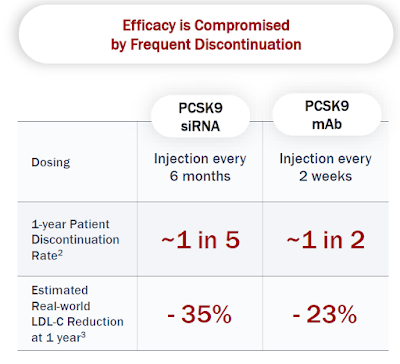


With this realization in mind, Verve Therapeutics set out to develop a PCSK9 CRISPR base editing treatment that should lower LDL-cholesterol for life by at least -40% after just a single administration of an intravenous LNP formulation.  Unfortunately, a first generation formulation, VERVE-101, had to be abandoned a year ago because of laboratory abnormalities, in particular ALT/AST elevations 5 to 10-fold above the upper limit of normal as well as a case of dangerously low platelet counts in a first clinical trial.  In addition, the intra-dose variability of the PCSK9 knockdown and LDLc lowering between subjects and the dose-responsiveness were not optimal.


Liver enzyme elevations (here ALT) with VERVE-101 in the HEART-1 study

All evidence pointed towards the LNP formulation, not the PCSK9 as the target or the base editing process, to be the culprit for the safety issues.  Verve therefore decided to replace some of the lipids in the liposomal formulation and add GalNAc sugars so as to allow the LNP to be taken up by both the LDL-receptor (via ApoE)- and ASGPR (via GalNAc).  This is helpful for two patient populations that are most in need for new treatment options and which lack LDL receptors (heFH and hoFH).  The base editor and guide RNAs were left unchanged from VERVE-101. 

Based on data from the first 14 subjects treated with VERVE-102 revealed today the theory translated perfectly into clinical practice.  At doses above 50mg of the LNP, the mean LDLc reduction was -59%, in line with the most potent PCSK9 agents (antibodies) and significantly more potent than inclisiran, especially in the heterozygous FH (heFH) population.  Moreover, there was a beautiful dose response for both PCSK9 and LDLc lowering and very little inter-patient variability.


Dose-related LDLc lowering in the HEART-2 trial with VERVE-102


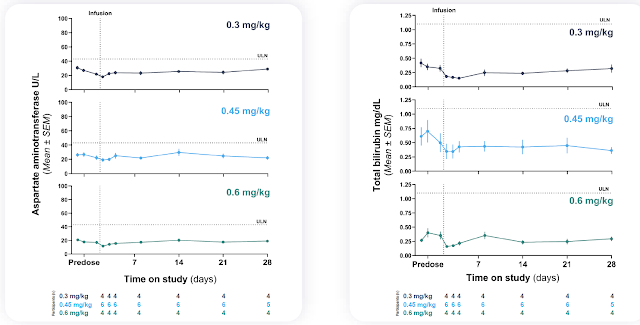
Even more importantly, the safety was pristine.  There was hardly a blip with no outliers in terms of ALT/AST changes upon LNP administration, a stark difference to VERVE-101.  Similarly, no platelet changes were seen.  Only a single case of grade 2 infusion reaction was observed which rapidly resolved and does not pose an obstacle to further clinical development and commercialization.  Anybody familiar with LNP technology understands that GalNAc-LNPs are now the gold standard in the delivery of genome editing in the liver.


Verve Therapeutics is wrapping up the HEART-2 study with a final higher dose to see whether there is further LDLc lowering and then proceed to a ~60-subject phase II study aimed at locking down one of two fixed doses of VERVE-102 for the registrational phase of clinical development.

Today marks a milestone in moving genome editing to large, indeed very large patient populations. 


Disclosure: I owned some Verve Therapeutics shares going into data and doubled down on it after seeing the emerging VERVE-102 product profile.


Tuesday, November 22, 2022

RNA Editing to Generate Protective Variants

Last week, ProQR participated at its first investor conference after a half year hiatus following a failed binary clinical read-out of a antisense splice modulator and corporate re-organisation to solely focus on RNA Editing.

To raise awareness of the company as a serious contender in this exciting field, the CEO detailed the new corporate strategy of growing the company as a major future biotechnology company.  This will be based on foundational IP, know-how and cash-generating partnerships as well as a broad internal pipeline reflecting the numerous ways RNA Editing can bring unique differentiation to addressing disease.  At the EuroTIDES two days later, the company provided scientific data illustrating the types of possible applications.

What caught my attention here is using RNA Editing for generating protective variants.  Protective variants are genetic variants in the human population that make carriers less likely to develop a disease.  PCSK9 and ApoCIII are well known in the cardiovascular field for those and have yielded promising therapeutics as a result.  Protective variants can also be found in other areas such as infectious disease (e.g. CCR5 and HIV) and Alzheimer's.

Not least because the story surprised and intrigued me for its translational potential, I will illustrate protective variant generation using RNA Editing taking PCSK9 as an example. 


Mimicking a PCSK9 mutation causing drop in bad cholesterol

With Inclisiran, an RNAi trigger suppressing the expression of PCSK9, RNA Therapeutics have become a commercial reality in cardiovascular disease aimed at very large populations.  A key attraction of this agent is the infrequent, semiannual dosing regimen that clamps down bad LDL cholesterol by ~-50%.

50%, however, somewhat lags the efficacy of the competitive PCSK9 monoclonal antibodies (~-60%) which have to be given at least monthly.  The fact that more robust LDL cholesterol lowering should therefore be possible also for RNA Therapeutics, the race for the most effective PCSK9 in this class is yet to be decided. 

Finding better RNA knockdown agents may be one, certainly attainable strategy, although AstraZeneca has just given up on an RNaseH antisense oligo that had looked promising in that regard.  Using an entirely new mechanism another.

Intriguingly, the sequencing of the PCSK9 gene in an individual with conspicuously low LDL cholesterol in Canadian Quebec province (Mayne et al. 2011) revealed that a Q152H variant in the heterozygous (!) state could lower circulating PCSK9 levels by ~-80% compared to the average, non-related population. This translated to a 60-70% LDLc lowering.  Subsequent cell culture experiments confirmed the causality of this mutation in regulating LDL-receptor levels via PCSK9 expression.  Curiously, while it was initially assumed that the mutation inhibited autocatalytic cleavage of pro-PCSK9, these experiments suggested that such mutant PCSK9s can also inhibit PCSK9 cleavage and subsequent export out of the cells in trans.  This dominant negative effect explains why the mutation in the heterozygous state could have such an outsized effect on serum PCSK9 and LDLc levels.


While other protective PCSK9 variants had been found before, this one was intriguing enough for ProQR to follow up on.  As histidine (H) is unlikely to be unique in messing up PCSK9 processing, ProQR chose QàR editing at the 152 site, possibly because glutamines cannot be converted into histidine via AàI editing, but also possibly because they suspected that the more highly charged arginine (R) residue could be even more impactful.


Impactful it was.  Even at only modest 25% editing (which certainly can, and has to be improved upon for further development), cleaved and secreted PCSK9 in cell culture was reduced by roughly -90%.   

It is important for the RNA Editing space to continue to advertise what the technology can do.  Because RNA Editing is not very useful as a genetic tool for general, academic molecular biology, the onus is on the companies to raise the awareness as some of the best translational ideas may come from scientists and physicians that have yet to hear about the technology.

Tuesday, October 30, 2018

RNAi is the Future of Cardiovascular Disease


At least, this is what Big Pharma and Biotech is saying right now following deals between pure-play RNAi companies Arrowhead Pharmaceuticals and Dicerna with Amgen and Eli Lilly, respectively, and the sale of The Medicines Company with its lead PCSK9 RNAi asset really being only a matter of timing.  Besides its new relationship with Eli Lilly announced yesterday, Dicerna has an ongoin CVD-related NASH/NAFLD collaboration with Boehringer-Ingelheim.  In addition, Wave Life Sciences and Akcea, the commercial Ionis spin-out, have been pursuing cardiovascular targets along with Pfizer and Novartis, respectively, using the competitive RNaseH antisense gene knockdown technology.

Drugging the undruggable

Part of the attraction of RNAi for CVD for the pharmaceutical industry is because the targets that come from large genetic studies (e.g. ApoCIII, Apo(a), ANGPTL3) based on chance alone are not readily druggable.  To make matters worse, amorphous lipid macromolecular aggregates are particularly difficult to target with either small molecules or antibodies.

Infrequent dosing

What a difference 10 years can make.  When Protiva (now Arbutus) was one of the first to enter a systemically administered RNAi therapeutic against LDLc-related ApoB into the clinic a decade ago, it often found itself ridiculed for using RNAi in such an indication.  Systemic RNAi back then required relatively frequent (1-3 weeks) intravenous administration which would make it an unlikely modality for widespread diseases that ideally require decade-long preventive treatment strategies.

Fast-forward to the present and now we have subcutaneously delivered RNAi with potential dosing frequencies of up to once-a-year as evidenced by the lead candidate of this crop, phase III asset Inclisiran by The Medicines Company.  If the remarkable safety profile holds up following about 2000 patient years of clinical experience, such a drug should be very widely prescribed, not least because it should enjoy great adherence, one of the major impediments of treatment success in cardiovascular disease.   

Undoubtedly, it has been the Inclisiran performance so far that has attracted the attention of players like Eli Lilly and Amgen, the latter of which, of course, should know particularly well about the competitive threat from RNAi having an antibody-based PCSK9 agent on the market (Repatha).  Beyond the upcoming slew of phase III read-outs with Inclisiran, it will equally be interesting to see the types of new targets being pursued and the clinical validation of targets like Apo(a) by the antisense competition.

By Dirk Haussecker. All rights reserved.

Disclaimer: This blog is not intended for distribution to or use by any person or entity who is a citizen or resident of, or located in any locality, state, country or other jurisdiction where such distribution, publication, availability or use would be contrary to law or regulation or which would subject the author or any of his collaborators and contributors to any registration or licensing requirement within such jurisdiction. This blog expresses only my opinions, they may be flawed and are for entertainment purposes only. Opinions expressed are a direct result of information which may or may not be accurate, and I do not assume any responsibility for material errors or to provide updates should circumstances change. Opinions expressed in this blog may have been disseminated before to others. This blog should not be taken as investment, legal or tax advice. The investments referred to herein may not be suitable for you. Investments particularly in the field of RNAi Therapeutics and biotechnology carry a high risk of total loss. You, the reader must make your own investment decisions in consultation with your professional advisors in light of your specific circumstances. I reserve the right to buy, sell, or short any security including those that may or may not be discussed on my blog.